



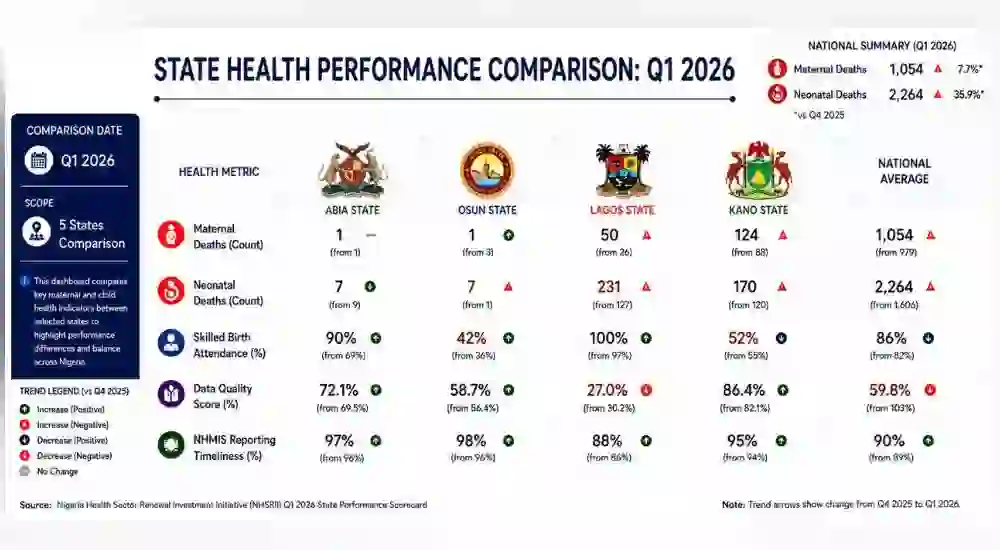
Nigeria recorded 1,054 maternal deaths in the first quarter of 2026, up from 979 in the previous quarter, even as Abia and Osun posted the lowest maternal death tolls in the country.
Neonatal deaths also rose sharply nationwide, climbing from 1,666 to 2,264 over the same period.
The figures are contained in the Q1 2026 quarterly performance scorecard released by the Sector-Wide Approach (SWAp) Coordination Office of the Federal Ministry of Health, under the Nigeria Health Sector Renewal Investment Initiative (NHSRII). The report tracks maternal health, immunisation, malaria treatment, non-communicable disease detection and mortality reporting across all 36 states and the FCT, drawing on the District Health Information System 2 (DHIS2) and the Maternal and Perinatal Death Surveillance and Response (MPDSR) platform.
Nationally, maternal deaths rose by 7.7 per cent between the fourth quarter of 2025 and the first quarter of 2026, while neonatal deaths jumped 35.9 per cent. Skilled birth attendance dipped slightly from 87 per cent to 86 per cent, but the share of pregnant women completing at least four antenatal visits improved from 48 per cent to 51 per cent.
Abia
Abia recorded one maternal death in Q1 2026, unchanged from the previous quarter, while neonatal deaths fell from 9 to 7. Full immunisation coverage rose from 69 per cent to 112 per cent, and skilled birth attendance climbed from 87 per cent to 90 per cent, above the national average.
The state’s ANC4/ANC1 ratio — a measure of continuity in maternal care — improved from 25 per cent to 37 per cent, though Penta-3 vaccine coverage slipped from 81 per cent to 76 per cent, and new family planning acceptors fell from 10 per cent to 8 per cent. Hypertension and diabetes detection rates also declined, while data-reporting timeliness improved to 97 per cent.
Abia allocated N152.4bn to health out of a N1.02tn total 2026 budget, according to BudgIT’s Health Financing in Nigeria report, placing it among nine states — alongside Bauchi, Kaduna, Kano, Ogun, Kwara, Nasarawa, Oyo and Taraba — that met the 15 per cent health financing benchmark under the 2001 Abuja Declaration.
Osun
Osun also logged one maternal death in Q1 2026, down from three in the previous quarter, though neonatal deaths rose from 1 to 7. Skilled birth attendance improved from 36 per cent to 42 per cent, still among the lowest nationally, while full immunisation coverage edged up from 59 per cent to 60 per cent.
The state’s data-reporting timeliness score reached 98 per cent, among the highest in the South-West. Osun budgeted N31.94bn for health in 2025 out of a N427.75bn total budget and spent N22.67bn — a 70.99 per cent performance rate, representing 7.47 per cent of its total budget.
Lagos
Lagos recorded the country’s highest skilled birth attendance rate at 100 per cent in Q1 2026, up from 97 per cent. But the state logged 231 neonatal deaths — the highest of any state — up from 127 in the previous quarter, with most cases traced to Lagos Island and Ikorodu. Maternal deaths in the state nearly doubled, from 26 to 50.
Full immunisation coverage fell from 62 per cent to 57 per cent, and new family planning acceptors dropped from 12 per cent to 7 per cent. Lagos led the nation in health spending in 2025, disbursing N180.99bn of a N216.71bn health budget — an 83.52 per cent performance rate — putting per capita spending at N10,812, among the highest nationally.
Other states
Nationally, new family planning acceptors fell 43.5 per cent, from 23 per cent to 13 per cent, while full immunisation coverage dropped 22.3 per cent, from 103 per cent to 80 per cent.
Kano’s maternal deaths rose from 88 to 124, concentrated in Bichi, Kano Municipal and Tarauni. Yobe recorded the North-East’s largest increase, from 61 to 75, while Kogi posted the North-Central zone’s biggest improvement, with deaths falling from 66 to 22.
Zamfara led neonatal death increases in the North-West, from 79 to 131; Gombe topped the North-East at 48 to 118; Ebonyi’s neonatal deaths doubled in the South-East, from 32 to 64; and Delta recorded the South-South’s steepest maternal death rise, from six to 22.
Financing gap
Nigeria’s health financing remains below international commitments, BudgIT’s report shows. The Federal Government allocated N2.48tn to health in its 2026 budget — about 4.2 per cent of the N58.47tn total budget, far short of the 15 per cent Abuja Declaration target.
Across 34 states tracked in 2025 (Akwa Ibom and Rivers were excluded for lack of implementation reports), health spending totalled N1.18tn of N1.97tn budgeted — a 61.74 per cent performance rate. Per capita spending ranged from N16,386 in Bayelsa to N808 in Cross River. Kano spent N63.06bn but recorded only N3,583 per capita due to its population of 17.6 million.
At the federal level, only N36m of N218bn allocated to health capital expenditure in 2025 was released. More than 75 per cent of Nigerians pay out of pocket for healthcare, the report found.
Data quality
National data quality stood at 59.8 per cent, marginally up from 59.7 per cent. Abia’s score rose to 72.1 per cent and Osun’s to 58.7 per cent, while Lagos fell to 27.0 per cent — the lowest in the country.
Jigawa, Kaduna and Kano posted the highest data quality scores nationally, all above 80 per cent, while Katsina, Kebbi, Sokoto and Zamfara recorded the lowest in the North-West, all below 47 per cent. In the North-Central zone, the FCT’s score fell from 70.9 per cent to 47.0 per cent, while Nasarawa recorded the zone’s highest at 72.3 per cent.
The NHSRII urged states to use the scorecard for quarterly advocacy and programme review, investigate coverage and data gaps, and institutionalise monthly data validation at state and local government levels.
READ ALSO:
- Adebayo Slams FG Over 30-Day Petrol Discount, Calls Tinubu’s Government ‘House Of Commotion’
- Trump rules out strike on Iran before November midterms
- Zlatan sets October 24 date for wedding to Davita
- Oyedele: NNPC Retail’s 30-day petrol discount is not a return to subsidy
- Amaechi Claims He Built Lekki Deep Seaport, Says Tinubu, Sanwo-Olu Took the Credit
