



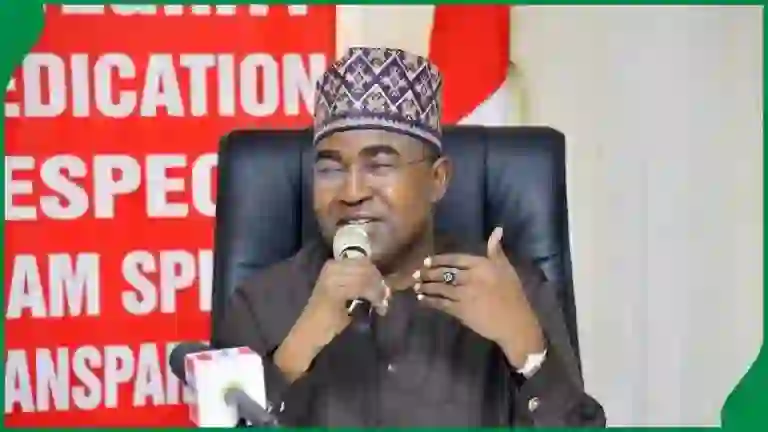
The Chairman of the National Drug Law Enforcement Agency (NDLEA), Brig. Gen. Mohamed Buba Marwa (Rtd), has told the United Nations General Assembly that the agency has transformed Nigeria’s drug control and delivered measurable results.
Marwa spoke on Monday at the 81st Session of the UN General Assembly in New York, held under the theme “Restoring Trust, Managing Transformation: A United Nations that Delivers for All.” He was represented by the NDLEA Secretary, Shadrach Haruna.
According to Marwa, the agency has moved beyond its enforcement-only roots to become an intelligence-led, people-centred body that combines law enforcement, public health, technology, financial investigation, alternative livelihoods and international cooperation.
He said the change was necessary because trafficking networks have grown more sophisticated, while technology has opened new routes for illicit activity and the movement of criminal proceeds across borders.
Between January 2025 and September 2026, he said, the NDLEA made 38,242 arrests, seized over 5.8 million kilograms of illicit drugs worth more than ₦2.5 trillion, and secured 6,232 convictions. Over the same period, more than 16,303 people received counselling, treatment or rehabilitation, while prevention and sensitisation campaigns reached millions of Nigerians.
“Nigeria therefore broadened its focus from drugs and offenders alone to the criminal networks, illicit profits and vulnerabilities that sustain the drug economy,” Marwa said.
He stressed that the agency’s priority is now dismantling major traffickers, organised structures and the financial networks behind the trade, rather than judging performance by arrests and seizures alone.
Marwa also highlighted the Alternative Development initiative, now being piloted in three communities in Ondo State, where residents are being supported to move from illicit cannabis cultivation to legitimate farming.
He cited the NDLEA’s Drug Integrity Test and Visa E-Administration System as examples of how digital tools can make public administration more accessible, efficient, transparent and accountable.
These reforms, he said, are being consolidated in the National Drug Control Master Plan 2026–2030, which rests on six pillars: drug supply reduction, drug demand reduction, access to controlled medicines, governance and coordination, alternative development, and disruption of the illicit drug economy.
Marwa urged the international community to strengthen timely intelligence-sharing so that criminal networks cannot exploit gaps between jurisdictions. He added that Nigeria is ready to share lessons, learn from others, and work with Member States, the UN and international partners to move “from commitment to implementation, from cooperation to collective action, and from transformation to measurable delivery.”
READ ALSO:
- Arise News Bans Anthony Kila From Its Platform Over Certificate Falsification Claims
- NASU to FG: Economic reforms must deliver relief, not deeper suffering
- Pope Leo XIV admitted to Rome hospital for lung nodule surgery
- FG Demands Arrest, Prosecution Of Suspect Who Stabbed Lab Scientist At FMC Abeokuta
- Military Retirees Barricade Pensions Board Office In Abuja
