



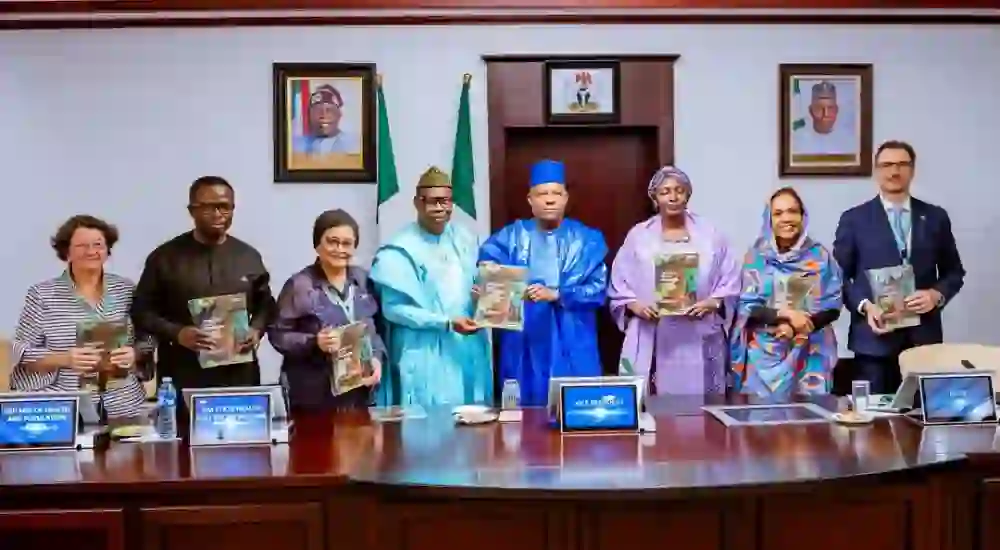
The Federal Government has said Nigeria will need about 315,000 community health workers by 2030 to strengthen primary healthcare and widen access to essential health services nationwide.
Vice President Kashim Shettima, who represented President Bola Tinubu, disclosed this on Friday in Abuja at the launch of the Community Health Programme Continental Acceleration Plan 2026–2030.
To close the gap, the government plans to recruit 100,000 salaried community health workers by the end of 2028. Shettima said the target falls under the Nigeria Health Sector Renewal Investment Initiative, which also provides for the revitalisation of over 17,000 primary healthcare centres and the training of 120,000 frontline health workers.
He said community health workers play a vital role in identifying maternal health risks, reaching unvaccinated children, collecting household health data and detecting disease outbreaks. He added that they must be given legal recognition, reliable pay, adequate support and equitable deployment for primary healthcare delivery to be sustainable.
Shettima also urged African countries to strengthen domestic financing of community health programmes and avoid continued reliance on external funding. According to him, countries must develop nationally owned implementation plans, set aside dedicated budgets and put effective monitoring frameworks in place so that commitments translate into measurable improvements.
The continental initiative brings together 51 African countries and more than 30 partners, with the aim of employing two million community health workers across Africa by 2030.
The Africa Centres for Disease Control and Prevention (Africa CDC) said the target builds on a 2017 African Union commitment, which has so far been met by just over half. It estimated that Africa would need $4.3bn annually to reach the goal, noting that every $1 invested could yield up to $19 in economic and social benefits. The agency described Nigeria’s plan to employ 100,000 salaried workers as a significant contribution to the continental target.
The Minister of State for Health and Social Welfare, Dr Iziaq Salako, commended Tinubu for approving Nigeria’s hosting of the high-level forum. He described the initiative as an important step towards strengthening community health systems and advancing primary healthcare across Africa.
The Coordinating Minister of Health and Social Welfare, Prof Muhammad Pate, was represented by the ministry’s Permanent Secretary, Daju Kachollom. She said the ministry remained committed to strengthening primary healthcare and expanding the community health workforce in line with the Renewed Hope Agenda and the Nigeria Health Sector Renewal Investment Initiative.
Kachollom acknowledged the contributions of the African Union Commission, Africa CDC, development partners and other stakeholders. She stressed that sustained investment, effective partnerships and coordinated implementation would be crucial to achieving the plan’s objectives.
READ ALSO:
- Kwankwaso Commends Tinubu For Deploying New Military Formations To Kano
- Between Tinubu and his predecessors, who is truly responsible for poverty in Nigeria? | By Seunmanuel Faleye
- Nigeria, Russia Begin Talks To Overhaul 1967 Aviation Agreement
- FG Says Nigeria Needs 315,000 Community Health Workers by 2030
- FG Begins Construction of 2,000 Renewed Hope Homes in Lekki With N100,000 Entry Deposit
