



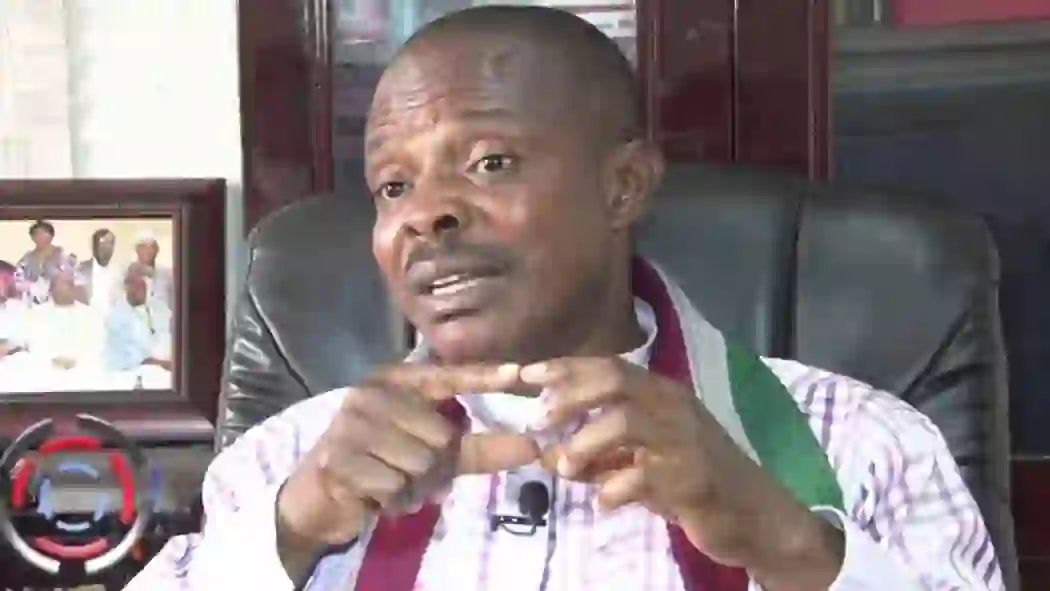
The President of the Nigeria Labour Congress (NLC), Joe Ajaero, has said President Bola Tinubu’s much-publicised “age of prosperity” has yet to translate into better living conditions for Nigerian workers.
Ajaero, who spoke during an interview on the Mic On Podcast hosted by Seun Okinbaloye, said rising prices of petrol, food, transportation and accommodation had continued to weaken workers’ purchasing power despite the government’s claim that inflation was slowing.
Tinubu had, in his October 1 Independence Day broadcast, declared that Nigeria had moved beyond the period of emergency economic reforms and entered what he described as an “age of prosperity.”
The President said the country had successfully passed through its economic “Red Sea” and was now heading towards a “Promised Land” of greater opportunities, abundance and shared prosperity.
However, Ajaero argued that the reality facing workers remained different.
“Prosperity is not with the Nigerian worker,” the NLC president said, while expressing hope that the government’s promise could eventually become a reality.
He said the reduction in the rate of inflation should not be mistaken for a reduction in the prices of goods and services, explaining that Nigerians were still paying significantly higher prices because of previous increases.
Using garri as an example, Ajaero explained that if the price of the commodity rose from N20 to N30 and later increased to N32, the slower increase did not mean the commodity had become cheaper.
He said the same principle applied to the broader economy, stressing that workers continued to face the accumulated impact of previous price increases.
N70,000 Minimum Wage Under Pressure
Ajaero said the N70,000 minimum wage agreed with the government was partly based on assurances that workers would receive relief from the consequences of petrol subsidy removal.
According to him, organised labour expected interventions such as cheaper Compressed Natural Gas (CNG) transportation, vehicle conversion kits, cash transfers and other measures to reduce the impact of rising living costs.
He, however, said many of the promised interventions had either not been implemented on the required scale or had failed to provide meaningful relief.
The NLC president also said some states had not properly implemented consequential adjustments arising from the new minimum wage, thereby leaving workers dissatisfied.
He explained that the N70,000 figure represented the minimum wage for the lowest level and step in the public service and should not be interpreted as the final salary of every public servant.
Ajaero further warned that even a N500,000 minimum wage could become inadequate if inflation and the cost of living continued to rise.
“If I get N500,000 minimum wage, and I can’t pay my house rent, of what use?” he asked.
He therefore advocated a wage system tied to the cost-of-living index or inflation, arguing that workers’ salaries should be reviewed automatically as the prices of essential commodities increase.
Ajaero Wants Cheaper Petrol
On petrol prices, Ajaero argued that Nigeria’s status as an oil-producing country should enable it to protect citizens from international price shocks.
He said the government should ensure that locally produced crude is supplied to domestic refineries at appropriate prices instead of forcing local refiners to purchase crude at international market rates.
According to him, such a policy could significantly reduce the cost of petrol.
Ajaero said petrol could potentially sell for around N500 per litre if crude produced in Nigeria was supplied to domestic refineries, adding that the price could even fall further if refining costs were properly managed.
He also questioned the continued practice of exporting crude oil while importing or pricing locally refined products based on international benchmarks.
The labour leader said domestic refineries, including the Dangote refinery and other private facilities, would be better positioned to provide affordable products if they had access to locally produced crude at reasonable prices.
He also called for greater investment in CNG infrastructure, saying the limited number of CNG buses and refuelling stations had not provided the expected relief to commuters.
Ajaero noted that distributing a few CNG buses across the six geopolitical zones could not significantly transform transportation in a country as large as Nigeria.
NLC Accuses FG of Poor Engagement
The NLC president also accused the federal government of failing to maintain adequate dialogue with organised labour on policies affecting workers.
He said the union had written to the President over several concerns and had at some point considered industrial action after failing to receive an adequate response.
According to him, intervention by some state governors was eventually required before discussions between labour and government could resume.
Ajaero said workers were also still waiting for some wage awards and other relief measures previously agreed with the government.
He warned that continued failure to address workers’ concerns could create conditions for renewed industrial action.
He stressed that organised labour was not opposed to economic reforms but wanted workers to be properly consulted on their implementation and protected from their negative consequences.
Ajaero Rejects Tinubu, Atiku and Obi’s Subsidy Positions
On the 2027 presidential election, Ajaero said he had examined the economic positions of leading political contenders and concluded that President Tinubu, former Vice President Atiku Abubakar and former Anambra State Governor Peter Obi held broadly similar positions on fuel subsidy removal.
He described the three politicians as supporters of a market-driven approach to the economy.
Ajaero, however, said the economic proposals of Accord Party presidential candidate Gbenga Olawepo-Hashim and Social Democratic Party candidate Adewole Adebayo deserved attention.
He said he had studied their positions and considered them sufficiently different from those of the major contenders.
The NLC president also stressed that the union had not endorsed any candidate ahead of the 2027 presidential election.
He said organised labour would engage presidential candidates and present a workers’ charter of demands, with the possibility of supporting candidates whose programmes align with the interests of workers.
Atiku Promises to Restore Fuel Subsidy
Meanwhile, Atiku Abubakar, presidential candidate of the African Democratic Congress (ADC), renewed his promise to restore fuel subsidy.
Atiku made the declaration during an impromptu encounter with Nigerians at an NNPC filling station in Guzape, Abuja.
When asked about his position on subsidy, Atiku responded in Hausa, “Zan dawo da tallafi insha Allah,” meaning, “I will bring back the fuel subsidy, by God’s grace.”
His running mate, Rotimi Amaechi, said an ADC government would reduce petrol prices by lowering the cost of production.
The development came shortly after the presidency challenged Atiku to explain the legal and financial basis of his proposal for a production subsidy on locally refined petrol.
Atiku Demands Explanation Over N11.2tn NNPC Receivables
Atiku also demanded greater transparency over N11.2 trillion recorded by the Nigerian National Petroleum Company Limited (NNPC) as other receivables from the Federation.
In a statement issued by his Director of Strategic Communications, Phrank Shaibu, Atiku demanded details of the contracts, payments and services connected to the funds, particularly those relating to the protection of Nigeria’s oil and gas infrastructure.
He questioned how much was spent on pipeline surveillance, who received the money and what results were achieved.
Atiku said the scale of the NNPC receivables warranted public scrutiny, especially when compared with the resources allocated to national defence.
He also demanded disclosure of contracts awarded by the Tinubu administration and questioned whether companies linked to individuals supporting the President’s 2027 re-election campaign had benefited from government contracts.
Falana, ASCAB Demand Petrol Price Reduction
Separately, human rights lawyer and Senior Advocate of Nigeria, Femi Falana, and the Alliance on Surviving Covid-19 and Beyond (ASCAB) called on the federal government to reduce petrol prices immediately.
The group argued that Nigeria, as a major crude oil producer, should be able to protect its citizens from the impact of international oil price shocks by prioritising domestic refining.
ASCAB also questioned Nigeria’s reliance on international pricing benchmarks and called for the country’s crude oil allocation for domestic refineries to be used to produce petroleum products for Nigerians.
The group maintained that increasing domestic refining and selling the resulting products at affordable prices would provide immediate relief to consumers and reduce the impact of global energy market disruptions.
The growing debate over petrol pricing, subsidy, wages and the cost of living is expected to remain a major issue ahead of the 2027 general election, with organised labour and political parties offering competing solutions to Nigeria’s economic challenges.
READALSO:
- Zamfara Speaker: Eight Lawmakers Were Already Suspended Before Dumping APC
- Suleiman Kum Takes Over as WAEC Nigeria Office Head
- Tinubu: New Army Formations Deployed Closer to Vulnerable Communities
- Ajaero: Tinubu’s Prosperity Promise Yet to Improve Workers’ Lives
- 2027: Umahi predicts Tinubu will gain more votes in South-East
