



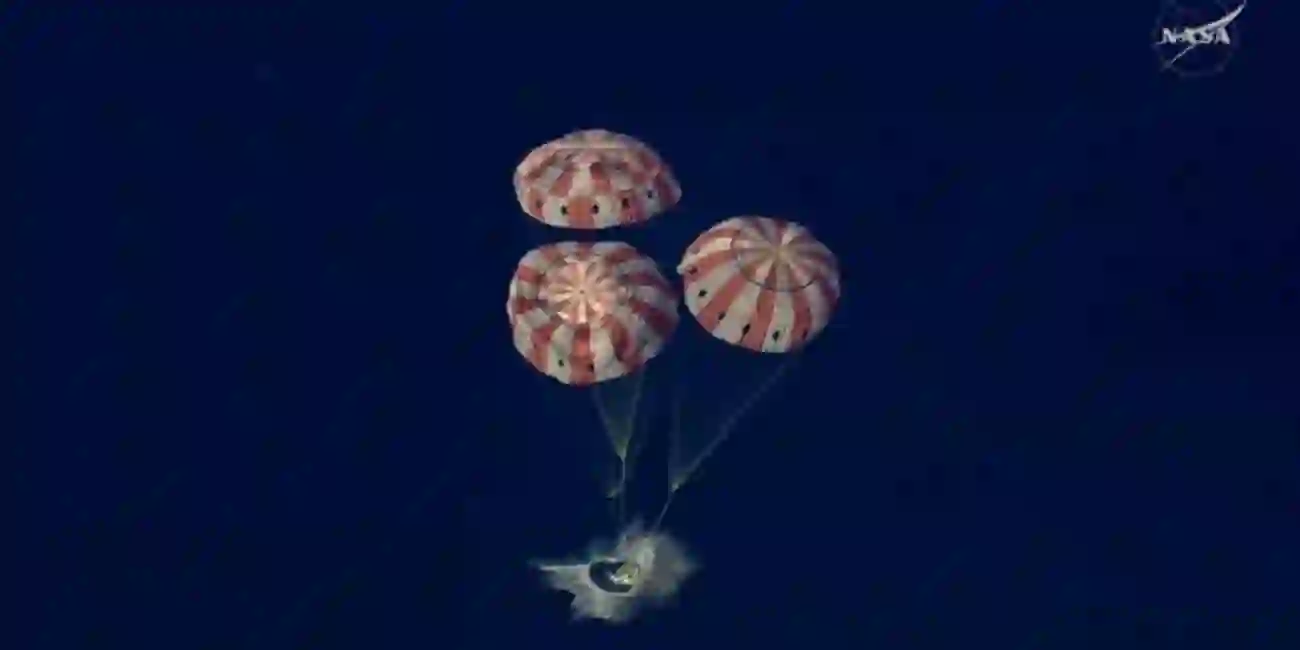
NASA’s Artemis II astronauts have returned safely to Earth, concluding a groundbreaking 10-day mission that carried humans farther into space than ever before and marked a major leap in deep space exploration.
The crew made a successful splashdown in the Pacific Ocean at 00:07 GMT, ending a carefully executed re-entry process described by officials as smooth and precise. Mission commander Reid Wiseman confirmed shortly after landing that all four astronauts were in good health, while NASA officials said the crew remained upbeat after the demanding journey.
The space agency described Artemis II as a crucial step toward a new era of human exploration, laying the foundation for future missions to the Moon and beyond.
One of the mission’s defining moments came on April 6, when the Orion spacecraft carried the astronauts 406,771 kilometres from Earth during a lunar fly-by — setting a new record for the farthest distance humans have ever traveled in space.
The return to Earth involved a series of complex maneuvers. At 23:33 GMT, the Orion capsule separated from its service module before re-entering the atmosphere at speeds exceeding 35 times the speed of sound. Communication was briefly lost for six minutes due to plasma buildup around the spacecraft, but contact was restored as it descended.
Parachutes deployed in phases slowed the capsule to under 200 feet per second before it landed near its target zone off the coast of San Diego.
Recovery teams acted swiftly. By 00:34 GMT, the astronauts had exited the capsule and were transported by boat before being airlifted to a U.S. Navy vessel for medical checks.
The crew included Christina Koch, Victor Glover, Jeremy Hansen, and Reid Wiseman, who described the mission as an extraordinary journey moments after landing.
Despite its success, the mission was shadowed by misinformation online, with false claims circulating across social media platforms suggesting the lunar fly-by was staged or digitally fabricated. Experts later debunked the viral content, identifying signs of manipulation and broadcast errors in widely shared images and videos.
Even so, Artemis II stands as a major milestone in space exploration, strengthening plans to return humans to the Moon, build a sustainable presence there, and prepare for future missions to Mars.
READ ALSO:
- Nine Escape Unhurt as Private Jet Loses Door Mid-Air After Abuja Takeoff
- Rone, Senator Gbenga Daniel, 28 Others Honoured at Megastar Man of the Decade Awards
- UK Lists Nigerian States Unsafe For Travel, Restricts Visits To Many More
- Africa’s Future Will Stall Without Young People at the Decision Table
- Anglican Church Suspends Awka Archbishop Ibezim Over Alleged ₦2bn Land Scandal
