



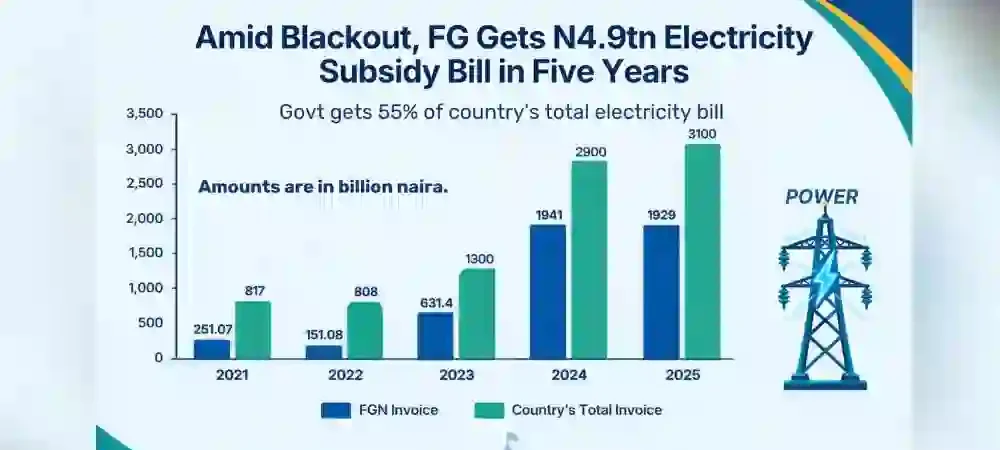
The Federal Government incurred N4.9 trillion in electricity subsidy invoices between 2021 and 2025, about 55 per cent of the N8.9 trillion total electricity invoices recorded over the period, even as Nigerians continued to endure blackouts and repeated grid collapses.
An analysis by THE WHISTLER of data published by the Ministry of Finance shows that the subsidy invoice rose from N251.07bn in 2021 to N1.929tn in 2025, with the sharpest increases in the last two years.
The subsidy invoice stood at N151.08bn in 2022 and rose to N631.4bn in 2023. It then jumped to N1.941tn in 2024 before settling at N1.929tn in 2025.
Total electricity invoices in the country were N817bn in 2021, N808bn in 2022, N1.3tn in 2023, N2.9tn in 2024 and N3.1tn in 2025.
On this basis, the subsidy invoice accounted for 30.7 per cent of total electricity invoices in 2021 and 18.6 per cent in 2022. The share rose to 48.5 per cent in 2023, 66.9 per cent in 2024 and 62.2 per cent in 2025.
Across the five years, the N4.9tn billed to the government represents 55 per cent of the N8.9tn total.
DisCo breakdown
Abuja DisCo recorded the highest subsidy bill over the period at N663.10bn, followed by Ikeja DisCo (N660.7bn), Ibadan DisCo (N613.58bn) and Eko DisCo (N564.96bn).
Others are Benin DisCo (N449.9bn), Enugu DisCo (N407.5bn), Port Harcourt DisCo (N378.2bn), Kaduna DisCo (N321.5bn), Jos DisCo (N310.7bn), Kano DisCo (N310.5bn) and Yola DisCo (N223.1bn).
Persistent outages
Nigerians have endured blackouts and erratic supply despite repeated government promises. There have also been controversies over the subsidy, with critics questioning whether the payments have translated into better electricity supply.
THE WHISTLER earlier reported that 15 state governments spent a combined N3.47bn on maintaining plants and generators in the first half of 2026. The figure, drawn from the states’ second-quarter 2026 budget implementation reports, shows continued reliance on alternative power sources by public institutions. The states had budgeted N13.77bn for the purpose for the full year.
The DisCos recently apologised to Nigerians over weeks of prolonged blackouts. Sunday Oduntan, Managing Director and CEO of the Association of Nigerian Electricity Distributors (ANED), made the apology on Channels Television’s Sunrise Daily on Monday.
“Apology is needed; it is essential because Nigerians have been taken through this problem over the past few weeks,” he said.
Grid collapses
The national grid collapsed on September 10, 2025, plunging the country into darkness. In March 2025, another major collapse affected several parts of the country, including Lagos, days after the Federal Government celebrated a “historic rise” in generation to 6,000MW. Output fell from about 4,000MW to below 1,000MW following the disturbance.
In January 2026, the grid collapsed again. The Nigerian Independent System Operator (NISO) said supply to all 11 DisCos dropped to zero megawatts at 11am, signalling a total system failure and triggering blackouts across several states.
READ ALSO:
- Neither constitution nor Anthem Act bans ‘Arise, O Compatriots’ – Onoh
- “Makinde will run into exile after 2027,” Fayose claims
- INEC debunks viral claim that BVAS can be remotely logged out during voting
- Abia Gets N1.04bn BOI Funding To Boost Small Businesses
- Nigeria Re-elected To ITU Council For 2027–2030 Term
