



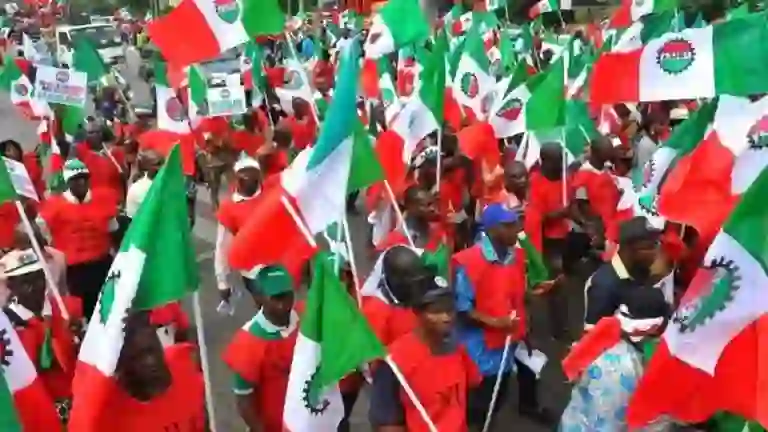
The Nigeria Labour Congress (NLC) has accused enemies of the working class of trying to sow confusion and division in the labour movement as negotiations for a new national minimum wage get under way.
In a statement signed by its Acting General Secretary, Comrade Benson Upah, the Congress said the aim was to shift blame and hide those truly responsible for wage outcomes.
“The enemies of the working class are attempting to sow confusion and division within our ranks by shifting blame and obscuring the true loci of responsibility as we begin the negotiation of a new national minimum wage,” the NLC said.
The Congress said it had noted with grave concern the deliberate spread of falsehood by opponents of the labour movement over the 2024 minimum wage exercise and the subsequent adjustment process. It said the statement was meant to inform the public, set the record straight and expose those misleading workers.
How the process works
The NLC explained that the national minimum wage is set through a tripartite process involving labour, government and employers’ representatives.
It said its mandate at this stage is to negotiate the minimum wage, which it described as the basic floor below which no worker should be paid and the foundation for all other wage structures.
Once the minimum wage is agreed, the Congress said, responsibility for negotiating consequential adjustments, which align existing wage structures with the new minimum, rests with the individual sectors. It described this as a fundamental principle of collective bargaining.
In the public sector, it said, the Joint Public Service Negotiating Council (JPSNC), made up of government representatives and about eight unions, negotiates implementation and adjustments with the federal government. State-level counterparts negotiate with state governments.
In the private sector, it added, industrial unions negotiate individually with employers’ associations. It cited the Association of Food, Beverage and Tobacco Employers (AFBTE), which negotiates with the National Union of Food, Beverages and Tobacco Employees (NUFBTE) on applying the minimum wage in that sector. The NLC said the same pattern holds across all sectors.
N40,000 claim rejected
Although the NLC represents both public and private sector workers, it stressed that it does not sit at the table to negotiate consequential adjustments. It said union leaders in each sector bear sole responsibility for the outcomes.
The Congress therefore dismissed claims that it negotiated the N40,000 across-the-board addition for federal workers as false and a deliberate distortion of the collective bargaining framework.
“The N40,000 outcome was the sole responsibility of the leadership of the unions in the public sector,” the NLC said.
It said anyone who attributes such outcomes to the NLC is either naive, ignorant or spreading mischief to mislead workers and the masses. It added that such a person lacks understanding of the basic structures of collective bargaining and should not hold leadership office in any union.
The NLC said Nigeria’s collective bargaining framework is statutory and backed by decades of tradition. It noted that throughout the history of minimum wage exercises, its leadership has never negotiated consequential adjustments with government or organised private sector employers. The JPSNC has always handled that for the public sector, while the Joint Industrial Negotiating Councils have done so for private sector industries.
“The NLC stands firmly with the Nigerian working class and masses, and we will not allow our movement to be misrepresented by those who serve the interests of capital and exploitation,” the Congress said.
Describing the coming negotiations as a critical moment, the NLC urged workers and the masses to hold specific institutions accountable for their specific responsibilities.
“The NLC will do its best to ensure that the outcome of this forthcoming exercise continues to serve Nigerian workers and masses and approximates a living wage,” it said.
It added that it would put measures in place to ensure that consequential adjustments are carried out by the relevant institutions in ways that benefit workers.
READ ALSO:
- Neither constitution nor Anthem Act bans ‘Arise, O Compatriots’ – Onoh
- “Makinde will run into exile after 2027,” Fayose claims
- INEC debunks viral claim that BVAS can be remotely logged out during voting
- Abia Gets N1.04bn BOI Funding To Boost Small Businesses
- Nigeria Re-elected To ITU Council For 2027–2030 Term
