



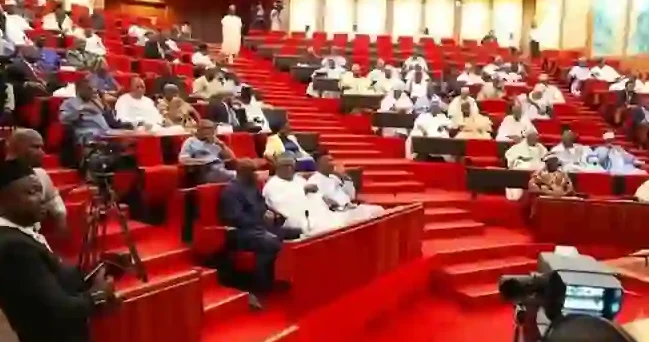
The National Assembly will this week transmit the State Police (Constitution Alteration) Bill, 2026, to President Bola Tinubu for assent, Senate Leader Opeyemi Bamidele has said.
Bamidele said 32 State Houses of Assembly have so far approved the amendment, which is above the number required by the Constitution. He added that the process would go ahead whether or not the four remaining assemblies submit their reports.
He spoke on Friday night in Lagos while receiving The Sun Senator of the Year Award at Eko Hotels and Suites, Victoria Island. He described the development as a breakthrough after more than 15 years of failed attempts to reform Nigeria’s policing system.
What the Constitution requires
Under Section 9(2) of the 1999 Constitution, an amendment must be backed by at least two-thirds of members in each chamber of the National Assembly and approved by no fewer than 24 of the 36 state assemblies. The 32 approvals exceed that threshold by eight.
The figure is up from the 30 Bamidele announced at plenary on November 4, when the Senate gave the six assemblies yet to respond until November 15 to state their positions.
Bamidele said the National Assembly still expected reports from the remaining assemblies as lawmakers resume on November 17, but insisted that their responses should not hold up further action.
“This is a responsibility we must consciously discharge on behalf of our constituents and in the interest of national peace, progress, and stability,” he said.
What the amendment does
The amendment would replace Nigeria’s wholly centralised policing structure with one in which state police services operate alongside the federal police. Section 214 of the Constitution currently establishes the Nigeria Police Force and bars the creation of any other police force for the federation or any part of it.
Completion of the amendment, however, will not immediately put state police formations into operation. According to the Presidential Working Group on the National Policing Bill, participating states will still need to pass their own enabling laws and have their services certified as meeting national minimum standards.
The proposed National Policing Bill is meant to provide the operational framework, covering standards, certification, inspections, information sharing, complaints, accountability and transitional arrangements.
The Policy and Legal Advocacy Centre has named sustainable funding, protection from political interference and effective oversight as critical to the system’s success. It has also urged the National Assembly to publish a consolidated record of authenticated state resolutions and clarify the bill’s transmission status.
Bamidele stressed that the system is not meant to create ethnic or state armies, but community-based policing structures operating within clearly defined constitutional safeguards.
He described the reform as part of the legislature’s effort to anticipate national challenges rather than react after crises occur.
“I believe in proactive lawmaking. I believe Nigeria must move from reactive governance to proactive governance. I believe our laws must be evidence-based, efficiently implemented, effectively monitored, periodically reviewed, and ultimately measured by their impact on citizens,” he said.
Award and legislative record
Bamidele received the award from the Founder of The Sun Publishing Limited and Chairman of the South East Development Commission, Senator Orji Uzor Kalu. He dedicated it to God, President Tinubu, the 108 other senators and his constituents, saying it reflected the collective effort of the 10th National Assembly rather than a personal achievement.
He said the legislature’s effectiveness should be judged by the impact of its laws, not the number of bills passed. Citing the student loan law, he said the Nigerian Education Loan Fund has disbursed more than N204 billion to applicants in 89 colleges, 108 polytechnics and 126 universities. According to him, the interest-free loans have helped students stay in tertiary institutions and reduced dropout risk.
He also listed legislation on social investment, minimum wage, tax reform, investments and securities, elections, insurance and regional development commissions among the current National Assembly’s major interventions. The insurance law is the Nigerian Insurance Industry Reform Act, 2025, which Tinubu signed in August last year.
Executive-legislature relations
On the relationship between the two arms, Bamidele said separation of powers should not be read as a licence for hostility.
“Separation of powers is not about hostility, but synergy; not grandstanding, but collaboration; not dissension, but interdependence among the arms of government,” he said.
He said he had carried out his legislative duties independently while working constructively with other arms of government in the interest of national development, peace and security.
Call for social media standards
Bamidele also called for a collective response to what he described as the irresponsible use of social media, citing character assassination, blackmail and the deliberate spread of false information.
While reaffirming his support for press freedom, an open parliament and engagement with journalists, he urged media organisations to help set standards for responsible information dissemination.
“We have seen characters assassinated. We have seen public institutions blackmailed. We have watched people deliberately distort facts. We have seen people unjustifiably peddling lies. We cannot fold our hands and allow this illegality to continue,” he said.
Bamidele, who said he has also been a victim, asked media stakeholders to consider whether digital platforms should remain unregulated given their influence on public life.
“The urgent questions are: Should we leave unregulated this space that defines our lives in the decades to come? Or do we prefer a space where characters are assassinated daily, lies peddled, and public institutions unjustifiably discredited?” he asked.
He specifically urged the Newspaper Proprietors’ Association of Nigeria, Broadcasting Organisations of Nigeria, Nigerian Guild of Editors and the Nigeria Union of Journalists to contribute to the discussion, saying information should be disseminated objectively and responsibly across traditional and digital platforms.
READ ALSO:
- Obi to publish 10-day “Record of Service” on Anambra tenure after Tinubu’s erosion jibe
- Meta Expands AI Age Detection Globally to Catch Teens Lying About Their Age
- Pyrates Raise Diabetes Awareness, Advocate Early Detection at OGBC 90.5 FM Radio Sensitisation
- ZENITH BANK USHERS IN YULETIDE SEASON WITH DAZZLING CHRISTMAS LIGHT-UP, MARKS 20 YEARS OF FESTIVE TRADITION
- Obi Condemns Attack On Kwankwaso’s Convoy In Kano, Demands Arrests
