



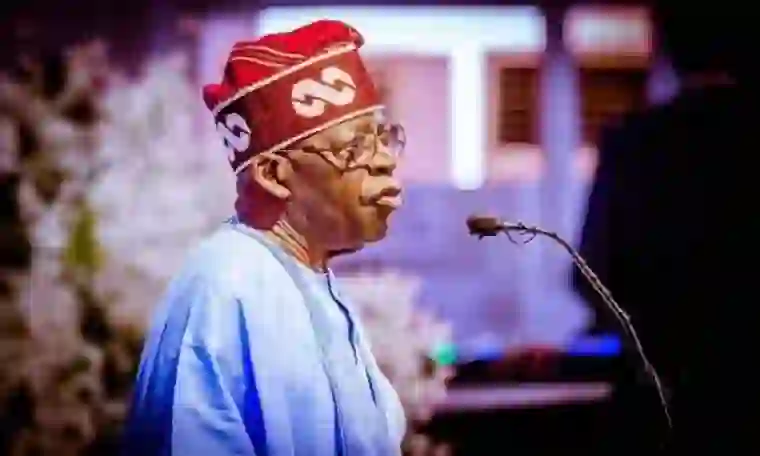
President Bola Tinubu’s campaign team has been shaken by an attack on his convoy outside the Shehu Shagari Mosque in Abuja on Friday, where he had gone for Juma’at prayers.
Videos reviewed show angry residents throwing stones at the convoy and shouting “We won’t vote for you,” along with other expletives. Gunshots were also heard as security operatives tried to push back protesters who surged forward.
Following the incident, presidential spokesman Bayo Onanuga posted a separate video showing Tinubu waving from an open vehicle to a group of people, most of whom appeared to be officials who had arrived at the mosque ahead of him. He described it as “original footage of the rousing welcome” the president received at Area 1 Garki Central Mosque. The clips reviewed did not appear to support that description.
Until Friday, the Presidency and the APC presidential campaign had regularly shared videos of Nigerians welcoming Tinubu and backing his return to power in 2027.
A week of bad publicity
The incident comes days after an on-air embarrassment for the campaign. Alwan Hassan, a member of the APC Presidential Campaign Council, appeared on Channels Television to discuss the president’s achievements nearly four years into his administration. Praising Tinubu for introducing the 112 emergency number, he challenged the host to “pick up your phone now, dial 112 and put it on speaker.”
The host could not complete the call after several attempts, and Hassan’s own attempt during the live broadcast also failed, to the dismay of even APC supporters.
The next day, the campaign council, through the Chief of Staff to the president, barred its spokespersons from granting media interviews. Only the designated spokesperson, the council chairman and the Minister of Information were exempted. Hassan was reportedly removed from the council afterwards.
The episodes add to the negative publicity from attacks on members of the Nigeria Democratic Congress (NDC), the Peoples Democratic Party (PDP) and the African Democratic Congress (ADC) in Delta, Ebonyi, Lagos, Rivers, Kano, Benue, Ekiti, Enugu, Anambra, Yobe, Sokoto, Kebbi, Zamfara and Plateau states, among others. Some of the attacks reportedly claimed lives.
Presidency’s call for peace
After the Abuja incident, Onanuga issued a statement, dated November 13 and signed by Tinubu, titled “Let’s Shun Violence: Our Campaigns Must Be About Issues That Promote The Welfare Of Our People.” It came despite earlier calls for Tinubu to rein in his supporters and government officials so opposition candidates could campaign freely nationwide.
In it, the president condemned political violence and urged leaders and supporters across party lines to focus on issues affecting Nigerians.
“Every form of violence stands condemned,” he said. “Violence should never have a place in our political campaigns as we move toward the 2027 general elections.”
He said campaigns should be “a contestation of ideas that promote the welfare of our people,” and committed himself to a peaceful, free and fair election.
Tinubu added that belonging to different parties does not make Nigerians enemies, describing them as “members of the same household living in different rooms.”
He also reiterated his directive to security agencies to be firm against anyone who tests the government’s resolve to preserve public order, and said all parties and candidates must be free to campaign anywhere without fear.
“We shall not tolerate any irresponsible conduct by politicians and their supporters,” he said, authorising security agencies to confront thuggery and other anti-democratic activities “with full force.”
Sowore: Where was this concern before?
Presidential candidate of the African Action Congress (AAC), Omoyele Sowore, criticised the call, accusing Tinubu of condemning violence only after experiencing hostility himself.
In a social media post, Sowore asked where the president’s voice was when APC operatives and supporters were accused of killing scores of people in Osun State during the recent governorship election.
He also said that on October 30, 2026, he and his team members were attacked in Ado-Ekiti by “assassins” sponsored by the APC and the City Boy Movement, which he linked to the president’s son. Sowore said he has publicly accused Ekiti State Governor Biodun Oyebanji, Special Adviser on Student Engagement Sunday Asefon, and the president’s son-in-law, Oyetunde Ojo, who is Managing Director of the Federal Housing Authority, of involvement. He demanded an independent investigation, adding that the principal suspects have not been brought to justice.
Sowore further cited an attack by thugs on an NDC town hall in Lagos, where Peter Obi was due to address supporters, as well as deadly violence involving APC supporters in Enugu and attacks on opponents in Delta.
“You cannot preach peaceful, issue-based campaigns only when political hostility reaches your doorstep,” he said.
READ ALSO:
- Obi to publish 10-day “Record of Service” on Anambra tenure after Tinubu’s erosion jibe
- Meta Expands AI Age Detection Globally to Catch Teens Lying About Their Age
- Pyrates Raise Diabetes Awareness, Advocate Early Detection at OGBC 90.5 FM Radio Sensitisation
- ZENITH BANK USHERS IN YULETIDE SEASON WITH DAZZLING CHRISTMAS LIGHT-UP, MARKS 20 YEARS OF FESTIVE TRADITION
- Obi Condemns Attack On Kwankwaso’s Convoy In Kano, Demands Arrests
