



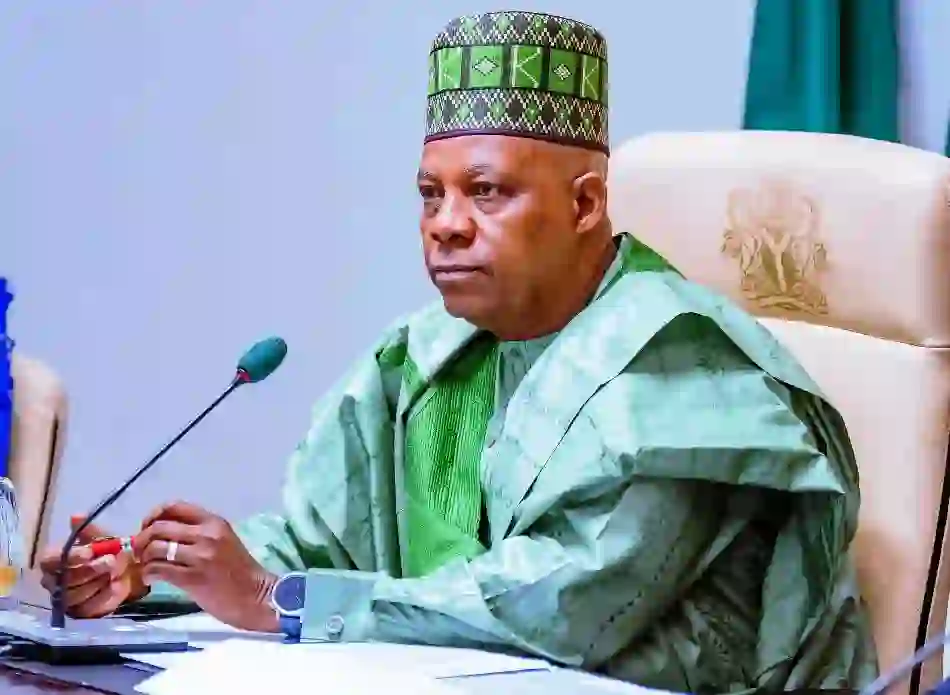
Vice President Kashim Shettima says Nigeria cannot hit its $1 trillion economy target while weak compliance, regulatory laxity and ethical ambivalence persist, insisting that only strong corporate governance can sustain the country’s economic ambitions.
Shettima spoke at the 3rd National Corporate Governance Summit in Lagos, organised by the Institute of Directors Centre for Corporate Governance (IODCCG) around the theme “Implementing Good Governance for Economic Acceleration, Consolidating Public-Private Partnership.” He said the theme aligns with President Bola Tinubu’s Renewed Hope Agenda.
The event was held in collaboration with the Financial Reporting Council (FRC), Ministry of Finance Incorporated (MOFI), and the Institute of Chartered Secretaries and Administrators (ICSAN).
Represented by Tope Fasua, Special Adviser to the President on Economic Affairs, Shettima said government reforms — subsidy removal, FX harmonisation, and the unbundling of strategic sectors — have laid the macroeconomic groundwork, but it is now up to the private sector to convert policy into jobs, goods and national wealth.
“Under this administration, our focus is on building a resilient, competitive and $1 trillion economy, driven by enterprise, systematic investments and comprehensive institutional reforms,” he said. “However, we must confront an undeniable truth. The lofty mountain of a $1 trillion economy cannot be scaled on the shaky terrain of weak compliance; it requires a bedrock of flawless governance.”
Referencing Nigeria’s existing governance frameworks — including the Nigeria Code of Corporate Governance, CAMA, and sector-specific codes from the CBN, NAICOM and SEC — the Vice President noted that the country’s history of corporate collapses stems not from a lack of ideas, but from insider abuse, creative accounting and reckless risk-taking.
He added that government is complementing private sector efforts by reforming state-owned enterprises through MOFI, cleaning up public procurement, and digitising government processes.
MOFI’s Managing Director/CEO, Dr Armstrong Takang, also addressed the summit, arguing that state-owned enterprises and strong corporate governance are essential to Nigeria’s $1 trillion ambition. He pushed back against the idea that government has no business in business, pointing to China, where central government SOEs manage at least $13 trillion in assets and drive infrastructure, technology and manufacturing on a global scale.
Mrs Uto Ukpana, President/Chairman of ICSAN’s Governing Council, said good governance is a strategic necessity rather than a mere administrative box to check. She said Nigeria’s challenge isn’t a shortage of policies, but the difficulty of translating policy into performance — which demands leadership commitment, ethical conduct, effective oversight, regulatory consistency, and accountability across public and private institutions.
Mr Urum Kalu Eke, Chairman of the Board of Governors at the IoD Centre for Corporate Governance, said: “When corporate governance is entrenched, institutions become stronger, accountability becomes the norm, investors’ confidence grows, and the economy is better positioned to achieve sustainable growth and long-term national development.”
READ ALSO:
- 2027: Sambo Says No Party Can Match APC’s Organisation
- Odumeje Reveals How Former Friends Attacked Him For Preaching Gospel
- Japan Festival Turns Tragic As Deputy Mayor Is Crushed To Death By Heavy Float
- 2027: Lagos APC Warns Peter Obi Against Relying on 2023 Popularity
- Musk promises SpaceX shares to every American child
