


Lagos State Governor, Babajide Sanwo-Olu, says the future of investment in Africa will be shaped less by continental or national policy and more by what happens inside cities — where infrastructure, businesses, and jobs are actually built.
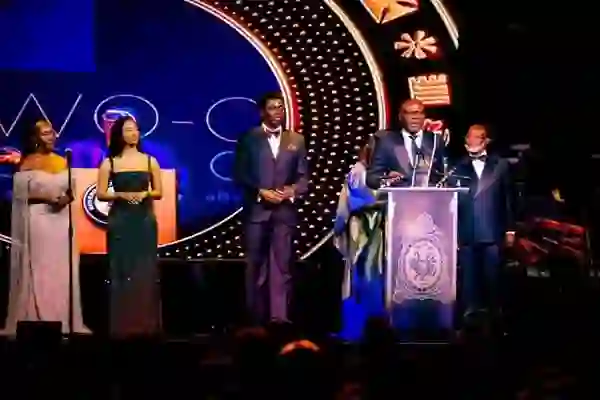
The Governor made the point while delivering a keynote at a dinner in Washington DC on Saturday, shortly after receiving the 2026 Global Transformation and Good Governance Prize from the Millennium Excellence Award, USA. The ceremony, held at the Warner Theatre, formed part of the 2026 Africa Business Investment Summit, organised by the Millennium Excellence Foundation at the MGM National Harbor in Oxon Hill, Maryland.
Speaking on the theme “Lagos and the Future of African Investment,” Sanwo-Olu held up Lagos as proof that strong urban governance, infrastructure investment, and private-sector partnerships can drive real economic transformation across the continent.
He noted that Lagos, though it covers less than 0.5% of Nigeria’s landmass, has a population bigger than the Netherlands and generates more than a quarter of the country’s economic output.
“Measured by purchasing power, our economy is worth around $259 billion — the second-largest city economy on the continent,” he said. “Our budget this year is N4.4 trillion, and more than half of it is capital spending. Lagos does not wait for the oil price to find out whether it can pay its teachers. Our internally generated revenue this year is projected above N3 trillion.”
On innovation, the Governor pointed to Lagos’s ranking by Startup Genome as sub-Saharan Africa’s top startup ecosystem, worth an estimated $8.6 billion and home to three unicorns and the region’s deepest tech talent pool.
He also touted major infrastructure wins: the $1.5 billion Lekki Deep Sea Port, which overtook Apapa in 2025 to become Nigeria’s busiest port by cargo volume, now handling about 40% of the country’s cargo traffic; and the 650,000-barrel-per-day Lekki Refinery, which he described as a turning point in Nigeria’s shift from crude exports to refined petroleum production.
On transportation, Sanwo-Olu said the Blue Line rail — West Africa’s first electric urban railway — has carried more than 8 million passengers since launch, while new eight-car trains procured for the Red Line will push daily capacity to 500,000 riders. He added that the €410 million Omi Eko water transport project will eventually deliver 75 electric ferries, 25 terminals, and 15 routes across the state.
“Lagos has set itself the goal of a one-trillion-dollar economy by 2052,” Sanwo-Olu said. “In Lagos, there is a saying every child, market woman and bus conductor knows: Èkó ò ní bàjẹ́ — Lagos will not spoil. It is a promise we make to ourselves every morning.”
He argued that with Africa projected to add nearly one billion urban residents by 2050, cities — not countries — must become the primary unit of the continent’s economic strategy, and urged investors to stop viewing “Africa” as a single bloc and instead assess individual cities on the strength of their governance.
Sanwo-Olu said he received the award on behalf of Lagos’s over 25 million residents and thanked the Asante Crown and the Millennium Excellence Foundation for the recognition.
READ ALSO:
- 2027: Sambo Says No Party Can Match APC’s Organisation
- Odumeje Reveals How Former Friends Attacked Him For Preaching Gospel
- Japan Festival Turns Tragic As Deputy Mayor Is Crushed To Death By Heavy Float
- 2027: Lagos APC Warns Peter Obi Against Relying on 2023 Popularity
- Musk promises SpaceX shares to every American child
