



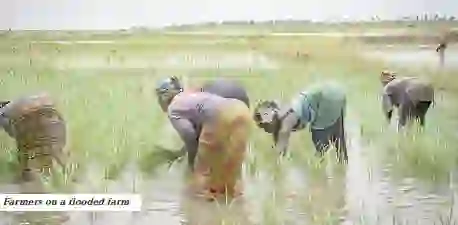
Climate change is increasingly threatening Nigeria’s food production as unpredictable rainfall, prolonged dry spells, flooding, rising temperatures, pests and crop diseases continue to disrupt farming activities and cause farmers to record significant losses.
Farmers and agricultural experts say the changing weather patterns are not only reducing crop yields but are also making farming more expensive and discouraging investment in agriculture, as producers and financial institutions face greater uncertainty over returns.
The situation is particularly concerning in northern Nigeria, where desertification and prolonged dry spells are affecting agricultural activities, while flooding in parts of the central and southern regions continues to destroy crops, wash away topsoil and damage farm infrastructure.
The Nigerian Meteorological Agency, NiMet, in its 2026 Seasonal Climate Prediction, warned of considerable variations in rainfall patterns across the country.
The agency projected early rainfall in several southern and North-Central states, while a delayed onset was expected in Borno State. It also forecast differences in the timing of the end of the rainy season, with some areas likely to experience early cessation and others longer-than-normal rainfall.
Although normal annual rainfall is expected across most parts of the country, NiMet projected above-normal rainfall in parts of the North, South-East, South-South and the Federal Capital Territory.
Below-normal rainfall was expected in parts of Katsina, Zamfara, Kwara, Oyo and Ogun states.
NiMet also warned of possible dry spells in parts of 14 states, including Bauchi, Borno, Gombe, Jigawa, Kano, Kebbi, Niger, Plateau, Sokoto, Yobe and Zamfara.
The changing weather patterns have raised concerns among farmers who say traditional planting calendars are becoming increasingly unreliable.
The Chairman of the All Farmers Association of Nigeria, AFAN, Dr Nkechi Okafor, described climate change as a major threat to food production, warning that its continued impact could force more farmers out of business and worsen food insecurity.
Okafor said farmers could no longer depend on established planting seasons because rainfall patterns had become increasingly unpredictable.
She explained that some farmers now plant following early rainfall only to experience prolonged dry spells afterwards, resulting in poor germination and reduced yields.
According to her, crops such as rice and root and tuber crops are particularly vulnerable when adequate water is unavailable.
She therefore called for increased investment in irrigation infrastructure and all-year-round farming to reduce farmers’ dependence on rainfall.
Farmers count huge losses
Okafor said Nigerian farmers were already suffering losses running into billions of naira because of climate-related shocks.
She stressed the need for stronger investment in farmers’ training and climate-smart agricultural practices, noting that many rural farmers still do not receive timely and useful weather information.
She also urged the government to tackle the high cost of agricultural inputs, pointing out that farmers were being squeezed by expensive seeds, fertiliser and other inputs while the prices of some farm products remained relatively low.
Okafor called for stronger cooperation between farmers’ associations, government agencies and other stakeholders to train farmers on how to adapt to changing weather conditions.
The Chief Farmer and Lead of JetFarmsNG, Jerry Olanrenwaju, said climate change was directly affecting crop production through irregular rainfall, prolonged dry spells and flooding.
He identified ginger, turmeric and garlic among crops affected by changing weather patterns.
According to him, irregular rainfall can affect germination and root development, while excessive moisture increases the risk of fungal diseases.
Olanrenwaju said some farmers within his company’s network had recorded yield losses of between 30 and 40 per cent in some seasons.
He explained that farmers who invest between N500,000 and N800,000 per hectare could lose hundreds of thousands of naira when adverse weather destroys their crops.
He said the uncertainty over when rainfall would start, stop or become excessive was making farm planning increasingly difficult.
To reduce the risks, he said JetFarmsNG was encouraging farmers to adopt climate-smart methods, including improved land preparation, organic soil improvement, better drainage and adjusted planting schedules.
The company is also exploring irrigation and water-management systems and working with partners to promote improved crop varieties that can withstand changing weather conditions.
Olanrenwaju, however, called for greater government support through extension services, affordable financing, agricultural insurance and reliable climate information.
Climate change increases farmers’ fears
The Co-Founder of DeBranch Farmers Limited, Sandra Victor-Gwafan, said climate change had created significant uncertainty among farmers in Kaduna and other parts of the country.
She said farmers could no longer confidently determine when to plant because early rainfall could suddenly stop, while heavy rainfall could arrive later than expected.
DeBranch Farmers, which works mainly with rice out-growers, has introduced measures including farmer sensitisation, drainage planning, coordinated mechanisation and staggered planting to reduce climate-related risks.
Victor-Gwafan said some farmers had invested between N250,000 and N400,000 per hectare on land preparation, labour and inputs but lost between 30 and 50 per cent of their expected harvest because of flooding and prolonged dry spells.
She urged the government and private sector to invest more in irrigation, climate-smart farming, resilient seeds, extension services, timely weather information and affordable agricultural financing.
A vegetable farmer in Osun State, Oluokun Remi, also said climate change was affecting the production of tomatoes, pepper, okra, cucumber, cabbage, onions and fruits.
He explained that excessive rainfall could wash nutrients away from plant roots, while insufficient or suddenly interrupted rainfall could damage crops.
Remi said he had started making irrigation arrangements before planting to ensure that his crops could survive when rainfall failed.
Experts demand urgent climate adaptation measures
Environmental expert, Prof. Babatunde Bolaji Bernard, said climate change had become an immediate threat to Nigeria’s agricultural productivity and food security.
He said farmers were facing erratic rainfall, delayed rains, prolonged dry spells, rising temperatures and flooding.
According to him, drought and desertification are particularly affecting northern Nigeria, while flooding in central and southern areas is destroying crops, eroding soil and damaging agricultural infrastructure.
He also identified heat stress, pests and diseases as growing threats to both crops and livestock.
Bernard said crops such as maize, rice, sorghum, millet and cassava were being affected by changing weather conditions, with the impact contributing to lower production, higher farming costs and rising food prices.
He called for the widespread adoption of early-maturing and drought-resistant crop varieties, improved irrigation, mulching, conservation agriculture, crop diversification and agroforestry.
He also advocated stronger weather information and extension services to help farmers make better planting and harvesting decisions.
At the policy level, Bernard urged increased investment in irrigation, rural roads, storage facilities, market infrastructure and agricultural insurance.
He further called for stronger measures against deforestation and land degradation, as well as greater use of international climate financing to support agricultural adaptation.
ActionAid seeks coordinated climate-resilience strategy
The Country Director of ActionAid Nigeria, Dr Andrew Mamedu, said climate change was already affecting millions of smallholder farmers, particularly women who play a major role in household food production.
He said farmers in northern Nigeria were dealing with drought, desertification and shorter rainy seasons, while communities in the Middle Belt and southern riverine areas were increasingly exposed to flooding.
Mamedu said climate shocks were disrupting planting calendars, reducing yields and increasing production risks.
He added that the effects extended beyond the farms, as extreme weather, poor storage, inadequate processing facilities and weak rural infrastructure were also contributing to post-harvest losses.
According to him, women farmers were particularly vulnerable because many face additional difficulties accessing land, finance, irrigation, extension services and climate information.
Mamedu acknowledged existing government and development-partner programmes on climate-resilient agriculture but said the overall response remained insufficient compared with the scale of the challenge.
He called for a shift from reactive interventions to a coordinated and adequately funded strategy for transforming Nigeria’s food system.
He urged greater investment in drought- and flood-tolerant crops, soil restoration, regenerative agriculture, sustainable livestock production, irrigation and water harvesting.
He also advocated climate-resilient storage facilities, cold chains, rural roads and local processing centres to reduce post-harvest losses and improve farmers’ incomes.
Mamedu further called for expanded access to affordable credit, agricultural insurance and targeted subsidies, particularly for women and young farmers.
Farmers urged to embrace agricultural insurance
The Global Head of Agricultural Risk at Leadway Assurance, Ayoola Fatona, urged farmers to include insurance in their budgets to protect their farms and investments against floods, drought and other climate-related risks.
Fatona said many smallholder farmers still regarded insurance as less important than seeds, fertiliser and other farm inputs.
He explained that farmers face significant exposure to weather-related risks and therefore need insurance protection as part of their overall farm-management strategy.
He urged farmers to consider insurance from the beginning of each planting season rather than waiting until disaster strikes.
The experts agreed that Nigeria’s food security will increasingly depend on the country’s ability to help farmers adapt to changing weather conditions through irrigation, improved seeds, climate information, insurance, financing, infrastructure and modern farming techniques.
Without stronger adaptation measures, they warned, climate-related disruptions could continue to reduce agricultural output, increase production costs and put further pressure on food prices.
READ ALSO:
- Aiyedatiwa pledges full support for NAF crash recovery in Ondo
- Climate change puts Nigeria’s food production under growing pressure
- World Bank warns high fuel prices will slow Nigeria’s poverty reduction
- EFCC asks court to disregard Diezani’s UK acquittal in asset forfeiture case
- Ogun Pays ₦3.5bn Severance to Former Council Officials, Beneficiaries Praise Abiodun
