



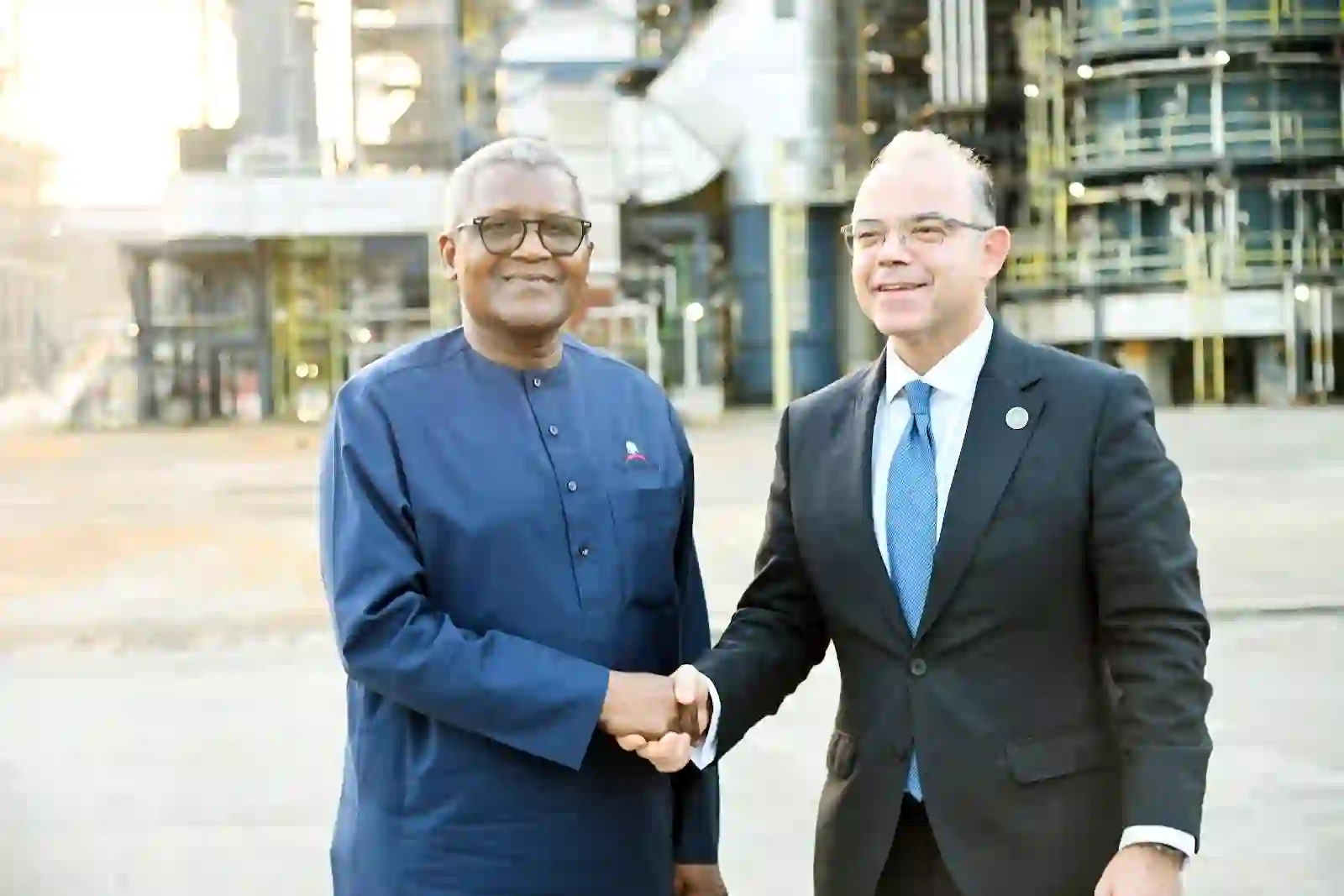
Dangote Industries Limited is exploring investment opportunities in Egypt, in a move that could deepen economic ties between Africa’s two most populous economies and advance its pan-African growth strategy.
The disclosure followed a visit to the Dangote Petroleum Refinery, Petrochemicals and Fertiliser complex in Lekki, Lagos, by a senior Egyptian government delegation led by the Minister of Investment and Foreign Trade, Dr. Mohamed Farid Saleh.
The delegation included the Egyptian Minister of Petroleum and Mineral Resources, Karim Badawi, the Vice Chairman of Egypt’s Investment Authority, Walid Anwar, and senior executives from the country’s oil and petrochemical sector. They met Dangote’s management, including President/Chief Executive Aliko Dangote, to discuss industrial collaboration, investment partnerships and capacity expansion.
Dangote described the visit as evidence of African economic integration.
“This demonstrates true African integration. It reflects our belief that African businesses must invest across the continent to accelerate industrialisation and economic development. We are proud to be an African company building industries that create value for Africa,” he said.
He added that the visit allowed the group to showcase its industrial scale while identifying areas of cooperation that could strengthen manufacturing capacity in both countries.
Saleh said the mission was aimed at converting ongoing diplomatic and business engagements between Nigeria and Egypt into concrete investments. He noted that it followed earlier interactions with the Dangote Group at the Alamein Economic Conference and other investment forums hosted by Egypt.
Egypt, he said, was keen to understand the capabilities Dangote has built in refining, petrochemicals, fertiliser production and related manufacturing.
“We are impressed by the scale of operations we have seen here, from refining and petrochemicals to fertiliser production. Our objective is to identify areas where Egyptian and Nigerian businesses can collaborate, expand industrial capacities and create long-term value for both economies,” he said.
The minister stressed that the private sector must drive the partnership.
“The private sector must be at the centre of this partnership. By learning from each other’s experiences and combining our strengths, we can expand industrial production, encourage investment flows and create sustainable growth opportunities for our people,” he said.
Saleh pointed to the combined market of about 400 million people in both countries, saying Nigeria’s energy resources and Egypt’s established industrial base offer a strong foundation for cooperation in manufacturing, energy, petrochemicals and fertilisers.
He said closer collaboration could encourage Nigerian industrialists to invest in Egypt, while giving Egyptian businesses a stronger presence in Nigeria. The benefits, he added, would extend beyond trade to job creation, technology transfer, skills development and the growth of supporting industries.
Asked whether Egypt would welcome a Dangote refinery, Saleh said the scope was much wider.
“It doesn’t have to be a refinery specifically. There are several sectors in which collaboration can happen. What is important is building a partnership that creates value for both countries and for Africa as a whole,” he said.
The engagement aligns with the Dangote Group’s Vision 2030 strategy, which seeks to widen its industrial footprint across Africa, strengthen regional value chains and position the continent as a globally competitive manufacturing hub.
Beyond refining and petrochemicals, opportunities are expected to emerge in fertiliser production, manufacturing, energy-related investments and industrial services.
READ ALSO:
- Dantsoho: Nigeria’s Exports Rise by 25% Under Tinubu’s Reforms
- Otti Charges Nigeria’s Elite To Take Responsibility For Good Governance
- Ogun Central PDP ticket: Court fixes November 19 to hear Amoo’s suit against Iyabo Obasanjo
- Onanuga ridicules Obi’s exhaustion, calls his campaign “doomed”
- Americans Vote in Midterms as Trump Faces Major Test Over Economy, Iran War
