



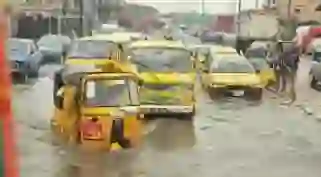
Torrential rain that pounded Lagos for over 12 hours has left homes submerged, roads impassable and commercial activity paralysed across the state, as residents battled rising floodwaters and government officials moved to enforce drainage laws.
The downpour, which began on Sunday and peaked in intensity, stranded motorists and commuters across the metropolis. Many residents were forced to bail water out of their homes, while anxious parents kept children home from school over safety concerns.
Areas hit hardest include the Lagos-Oshodi Expressway, Abeokuta Expressway, Lekki-Epe Expressway, Victoria Island, Agege, Ikeja, Oworonsoki, Gbagada, Funsho Williams Avenue, Iwaya, and other low-lying and coastal communities. By 11am, floodwater had overtaken the bridge linking Ojota to Maryland along Ikorodu Road, trapping vehicles. Lekki and Oshodi saw buildings submerged and cars floating in stormwater.
Business premises shut their doors, bus stops emptied as commuters sought shelter, and though the rain eased by around 2pm, it left behind heavy gridlock and residents effectively trapped indoors.
Commuters, teachers describe the toll
Residents described chaos on the roads. A Yaba resident, Wasiu, said blocked and overflowing drainage channels made it nearly impossible to get to work, while some transport operators hiked fares to exploit the situation. A primary school teacher, Ade Bambo, said pupil attendance collapsed as parents kept children home for safety.
In Okota’s Ago Palace Way, a resident named Kunle said the flooding escalated from light rain to waist-deep water within an hour. Gbagada saw similar disruption, with tricycle and bus operators suspending services and motorists rerouting toward Anthony, Maryland and Ojota.
In Isashi, Iba, Ojo and Okokomaiko, three days of continuous rain forced residents to abandon homes entirely. One resident, Joel Ubah, said his four-bedroom bungalow — completed just over a year ago — was now uninhabitable, and appealed to the state government for urgent intervention, warning that continued flooding could cause building collapses.
Government response
Commissioner for Environment and Water Resources, Tokunbo Wahab, said climate change and worsening drainage encroachment mean flash flooding will keep recurring, but insisted government was ramping up resilient infrastructure. He blamed the Ikorodu flooding on a construction contractor who had dammed a downstream channel for site work.
Wahab announced a crackdown on illegal structures built on drainage channels, floodplains and natural water corridors, warning that violators would be removed “regardless of ownership.” He cited encroachment in Agungi and Lekki, ordered demolitions at Mehabond Estate, and flagged alleged illegal wetland reclamation near Graceland Estate and unauthorised river narrowing by a developer at Ikota River.
The state also vowed to block an ongoing federal reclamation project at Kuramo Beach, which Wahab said threatens a critical water body.
Governor Babajide Sanwo-Olu has since approved dredging of 28 additional primary drainage channels statewide. Officials noted Lagos’s complex network of lagoons, rivers and tidal waters slows stormwater discharge, worsening flooding in low areas during high tide — and stressed that similar extreme rainfall hit other African countries and parts of North America the same week.
Urban planner Michael Simire attributed the flooding to high rainfall intensity, poor and blocked drainage, low-lying coastal terrain, and weak enforcement against structures encroaching on waterways.
No casualties had been reported as of filing.
READ ALSO:
- Governor Otti, Westbrook, and Karl Kani to Be Honored at 5th Afro Awards in Los Angeles
- Aiyedatiwa pledges full support for NAF crash recovery in Ondo
- Climate change puts Nigeria’s food production under growing pressure
- World Bank warns high fuel prices will slow Nigeria’s poverty reduction
- EFCC asks court to disregard Diezani’s UK acquittal in asset forfeiture case
