


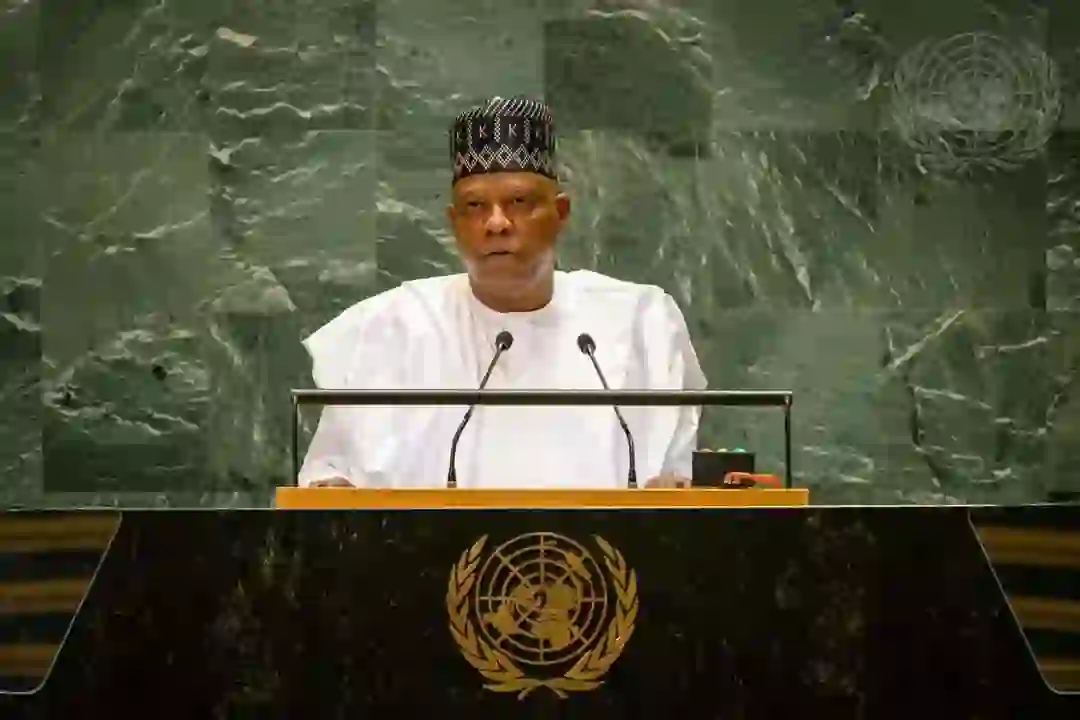
Nigeria has told the United Nations that strong national defences alone cannot shield any country from terrorism, cyberattacks and other threats that now move freely across borders.
Vice-President Kashim Shettima delivered the warning on Thursday while reading President Bola Tinubu’s national statement at the 81st UN General Assembly in New York.
Citing Nigeria’s long fight against Boko Haram, ISWAP and other armed groups, Shettima pushed for deeper international cooperation against threats that ignore national boundaries. He argued that modern security challenges exploit the gaps between countries and cannot be defeated through isolated, go-it-alone responses.
According to him, Nigeria’s experience shows that cross-border threats demand matching regional and global cooperation. While military action remains necessary, he said it cannot on its own guarantee lasting victory over violent extremism — sustainable security also requires education, economic opportunity, accountable governance and respect for human rights.
Shettima tied this to Nigeria’s broader push for collective security and stronger multilateral institutions, stressing the country’s readiness to work with neighbours and global partners against terrorism and other destabilising forces. He pointed to Nigeria’s continued role in ECOWAS, the African Union and Gulf of Guinea partnerships, spanning mediation, counter-terrorism, maritime security and democratic governance support.
He also recalled Nigeria’s history of contributing troops and resources to peacekeeping across Africa, citing missions in Liberia, Sierra Leone, Darfur, Mali and The Gambia as proof that Nigeria acts on instability beyond its own borders — because conflict in one country inevitably spills over into others.
Shettima cautioned world leaders against assuming distant wars carry no cost for nations far removed from them, warning that conflict disrupts trade, fuels humanitarian crises, drives displacement, strengthens extremist networks and triggers wider economic and security shocks. He called for renewed commitment to dialogue, mutual respect, collective responsibility and international law, reaffirming Nigeria’s support for resolving disputes peacefully under the UN Charter.
He singled out Sudan and other conflict-hit nations as needing urgent diplomatic attention given the toll on civilians and regional stability, and warned against rising nationalism and fading commitment to multilateralism — trends he said undercut the very reason the UN was founded after World War II.
Shettima said Nigeria remains committed to an international order built on diplomacy rather than raw power, adding that insecurity and institutional weakness can erode even hard-won military gains. He called for stronger global institutions capable of coordinating responses to terrorism, cyber threats and other borderless dangers.
Shettima spoke fourth during Thursday’s afternoon session as the General Debate entered its third day. He closed by urging greater international solidarity, regional leadership and sustained investment in the social conditions that sustain peace.
READ ALSO:
- Sowore Joins Free Palestine Protesters In New York, Condemns Israel’s Gaza War
- Nigeria to UN: No Nation Is Safe From Global Threats Behind Its Borders
- Amnesty International demands scrapping of ICE over rights abuses
- Tinubu Tells UN: 1945 World Order Can’t Govern 2026
- 2027: Elections Must Be Decided at the Polls, Not in Court — Onaiyekan, Osigwe
