



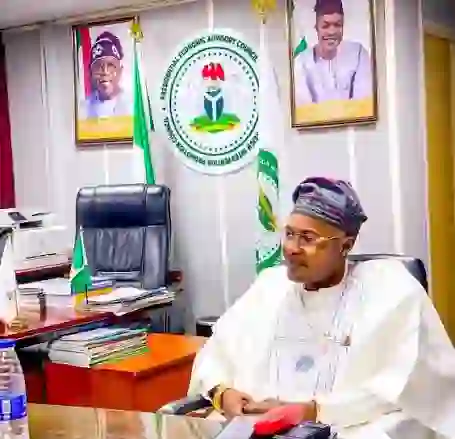
The controversy surrounding the alleged Presidential Foreign Intervention Promotion Council (PFIPC) intensified on Wednesday as the council’s embattled Director-General, Adeniyi Adeyemi, declared his readiness to submit documents to security agencies to aid ongoing investigations into the controversial N1.3 billion allocation in the 2026 budget.
The development comes after President Bola Tinubu directed the Independent Corrupt Practices and Other Related Offences Commission (ICPC) to investigate the circumstances surrounding the inclusion of the council in the national budget, despite the Presidency maintaining that the PFIPC is not a legally recognised government agency.
Speaking during an online interview with social media personality VeryDarkMan, Adeyemi said he was willing to cooperate with investigators by handing over all documents in his possession to the Department of State Services (DSS), the Nigeria Police Force, or any investigative panel constituted by the Federal Government.
According to him, the documents should be carefully verified to establish the facts behind the controversy.
Adeyemi questioned how an agency that the Presidency now describes as non-existent could have appeared in the 2026 Appropriation Act.
He also denied allegations that he was responsible for inserting the budget allocation, explaining that he was in detention for 23 days while the budget was being prepared and therefore could not have participated in either the preparation or defence of the proposal.
“I am ready to assist security agencies or any panel set up by the President. I will submit every document in my possession so they can verify the facts and uncover the truth,” he said.
Responding to previous allegations involving the President’s Chief of Staff, Femi Gbajabiamila, Adeyemi declined to accuse or exonerate him, insisting that only an independent investigation could determine those responsible.
He also revealed that he survived an attack by gunmen near Zuma Rock in September 2025 and maintained that his involvement with the council was motivated by his desire to attract foreign investment into Nigeria.
Meanwhile, the National Assembly recorded differing positions over the controversy.
The House of Representatives resolved to investigate how the disputed agency secured a budgetary allocation of over N1.3 billion in the 2026 Appropriation Act.
Lawmakers constituted an ad hoc committee to determine how the council allegedly bypassed official verification processes before being included in the national budget.
The committee was directed to invite the Minister of Budget and Economic Planning and the Director-General of the Budget Office to explain the approval process and identify possible lapses.
The House also instructed the Office of the Accountant-General of the Federation to ensure that no funds are released to the agency pending the outcome of investigations.
In addition, lawmakers recommended that future appropriation bills should include a comprehensive list of all Ministries, Departments and Agencies (MDAs), alongside the legal instruments establishing each institution, to prevent similar incidents.
Chairman of the House Committee on National Security and Intelligence, Ahmed Satomi, described the development as a serious threat to the credibility of Nigeria’s budget process, while Deputy Speaker Benjamin Kalu disclosed that even his office had initially accepted documents presented by the group because they carried official government insignia and appeared authentic.
Unlike the House, the Senate declined to commence a separate investigation.
Deputy Senate President Barau Jibrin, who presided over plenary, ruled that the upper chamber should await the outcome of the ICPC investigation before taking further legislative action.
The decision came after Senator Kawu Sumaila attempted to move a motion calling for an investigation into the allocation.
Barau argued that since the Presidency had already mandated the ICPC to investigate the matter within 30 days, the Senate should allow the anti-graft agency to complete its assignment before deciding on any additional action.
Outside the National Assembly, the controversy continued to generate political reactions.
Former Vice President Atiku Abubakar criticised the President’s directive, arguing that the Federal Government could not investigate itself in a matter involving allegations against officials within the Presidency.
He called for the establishment of an independent commission of inquiry comprising representatives of the Nigerian Bar Association (NBA), opposition political parties, civil society organisations and retired judicial officers.
According to Atiku, an administration linked to the controversy should not serve as both investigator and judge.
The African Democratic Congress (ADC) also rejected the ICPC investigation, expressing concerns over the commission’s independence.
The party alleged that the Presidency had already prejudged the outcome by describing Adeyemi’s documents as forged before investigators had examined them.
The ADC further condemned the reported arrest of Adeyemi’s father by security operatives, describing the action as intimidation and urging that investigations be conducted independently and transparently.
The ICPC is expected to conclude its investigation within the 30-day period directed by President Tinubu as public attention remains focused on how the disputed agency appeared in Nigeria’s 2026 budget.
READ ALSO:
- Makinde Accuses Tinubu Government Of Worsening Nigerians’ Hardship
- Tinubu Holds Closed-Door Talks With NELFUND Boss Ovia in Abuja
- Ebola: Senate Orders Compulsory Screening For All Travellers, Demands Release Of ₦10bn
- Oyebanji Names Four New Aides to Oversee Power, Roads, Airport and Transport
- Family of Late Gospel Singer Toluwanisings Fixes Date for Service of Songs
