



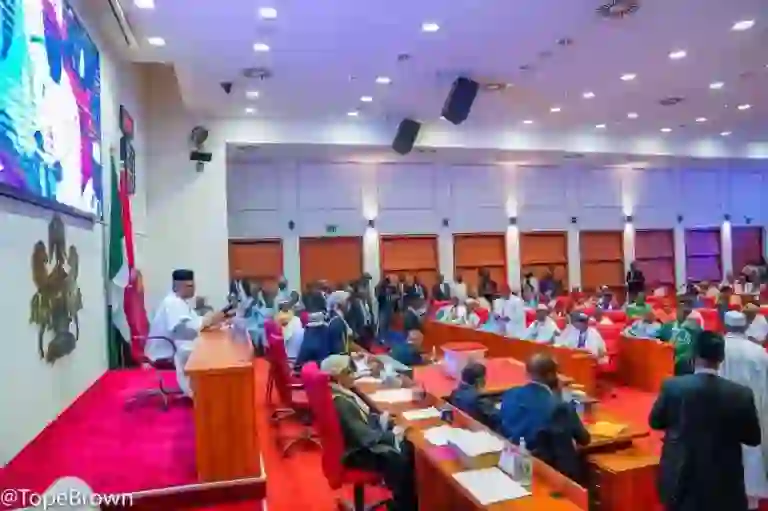
The Nigerian Senate on Wednesday opened what may rank among the most significant constitutional amendment exercises since the country’s return to democratic rule in 1999, with lawmakers set to decide on a sweeping package of proposals covering security, elections, justice and human rights.
At the centre of the exercise is the bill seeking to establish State Police Services — a measure championed by President Bola Tinubu’s administration as part of a broader response to the country’s worsening security situation.
Full List of Proposals Before the Senate
Beyond the state police bill, senators are expected to vote on six other far-reaching amendments:
- Establishment of an Electoral Offences Commission to investigate and prosecute electoral crimes
- Introduction of independent candidacy for governorship, legislative and local government elections
- Placement of the Armed Forces on constitutional first-line charge, guaranteeing direct funding from the Consolidated Revenue Fund
- Constitutional recognition and financial autonomy for traditional rulers through State Councils of Traditional Rulers
- Automatic commutation of death sentences for pregnant women to life imprisonment upon confirmation of pregnancy
- Prohibition of the public parade of criminal suspects by law enforcement agencies, on grounds that it violates human dignity and the presumption of innocence
The session drew prominent figures from Tinubu’s inner circle, including Chief of Staff Femi Gbajabiamila and the governors of Kaduna, Ogun and Ondo states. Several state Attorneys-General, including representatives from Anambra and Akwa Ibom, were also in attendance.
Their presence raised eyebrows within the chamber, as non-members rarely attend such critical legislative sessions. Sources indicated some senators initially objected to admitting the visitors, but they were eventually allowed in to observe.
Proceedings were delayed after the chamber entered a closed-door session lasting over an hour, following a motion by Senate Leader Opeyemi Bamidele.
Senate President Godswill Akpabio set the tone ahead of the closed session, framing the constitutional amendment exercise as a defining test of the 10th Senate’s legacy.
“The decisions we take will have the potential to shape the future of policing, public safety and intergovernmental relations in Nigeria for generations to come,” he said, urging senators to approach the debate with patriotism and commitment to the national interest.
In a notable procedural shift, Akpabio announced that voting would be conducted electronically — with each senator’s vote digitally recorded, displayed and printed — marking the first deployment of the technology for constitutional voting in the 10th Senate. A test run of the system was conducted before deliberations began.
Supporters of the state police bill argue it would sharpen intelligence gathering, reduce response times and bring law enforcement closer to local communities. Critics, however, warn that the structure risks being weaponised by governors for political ends, particularly as the country heads toward another election cycle.
Proceedings were still ongoing as senators prepared to cast their votes.
READ ALSO:
- Governor Otti, Westbrook, and Karl Kani to Be Honored at 5th Afro Awards in Los Angeles
- Aiyedatiwa pledges full support for NAF crash recovery in Ondo
- Climate change puts Nigeria’s food production under growing pressure
- World Bank warns high fuel prices will slow Nigeria’s poverty reduction
- EFCC asks court to disregard Diezani’s UK acquittal in asset forfeiture case
