


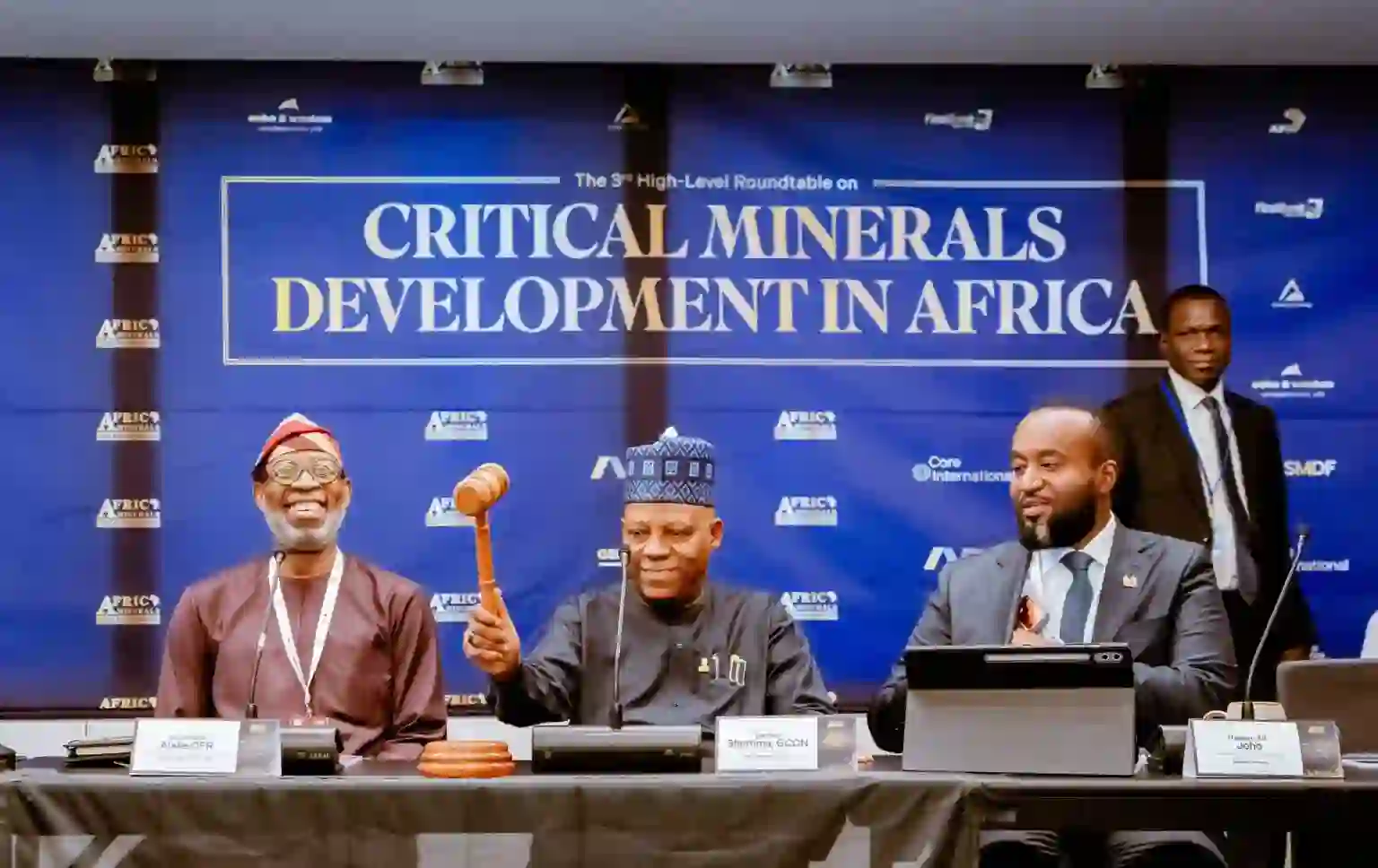
President Bola Tinubu has called for a united African front to end the exploitation of the continent’s critical mineral resources, urging nations to move from merely supplying raw materials to building local processing and manufacturing capacity.
Represented by Vice-President Kashim Shettima, Tinubu made the call at the third Africa Minerals Strategy Group (AMSG) High-level Roundtable on Critical Minerals Development in Africa, held on the sidelines of the 81st UN General Assembly session in New York.
The roundtable, convened and chaired by Tinubu alongside AMSG Chairman and Minister of Solid Minerals Dr Dele Alake, carried the theme “From Resources to Wealth: Continental Cooperation for Mineral Value Addition, Data Sovereignty, Innovative Financing and Critical Minerals Security.”
Tinubu said Africa could not claim to be wealthy while communities living around its mines remained in poverty. “For generations, Africa has furnished the materials of prosperity elsewhere. Our duty is to ensure that the future being fashioned from African minerals has room for African ambition,” he said.
He noted that rising global demand for clean energy, artificial intelligence and advanced manufacturing had made Africa’s critical minerals indispensable to global supply chains — yet mineral-rich communities still lacked basic infrastructure and jobs. The solution, he said, lay in processing, refining, battery production, component manufacturing and skills development.
Tinubu warned that no single African country could achieve this alone, and that competing through lower royalties or weak local content requirements would only erode the continent’s bargaining power. “Fragmentation leaves us exporting raw materials and buying finished goods at a premium. Cooperation gives our markets scale, our industries integration, our financing reach and our negotiations authority,” he said.
On Nigeria’s own reforms, he said new mining licences now require local value addition, alongside efforts to strengthen geological data, organise artisanal miners into cooperatives, and clamp down on illegal mining. He cited a sharp rise in solid minerals revenue — from about ₦6 billion in 2023 to over ₦38 billion in 2024, and between ₦68.1 billion and ₦70 billion in 2025 — along with new lithium processing capacity commissioned in Nasarawa State as evidence that “firm terms can attract serious capital.”
He called for partnerships built on mutual benefit and sovereign equality rather than dependency, and urged AMSG member states to speak with one voice in global negotiations.
At the roundtable, member states adopted the Continental Integration and Economic Assurance Declaration (CIEAD), which Alake described as a framework for a unified architecture across Africa’s critical and solid mineral value chains. Tinubu said the declaration’s impact must extend beyond the signing ceremony through a binding programme with clear timelines, financing and accountability mechanisms.
Kenya’s Minister of Blue Economy and Maritime Affairs, Hassan Ali-Joho, stressed the importance of domestic resource mobilisation in driving mineral sector development across the continent, calling on AMSG members to remain transparent and aligned on licensing procedures.
READ ALSO:
- Trump Launches “Trump TV” as White House Bars CNN, MS NOW, Politico Over Coverage Dispute
- “Not A Threat, But A Promise” — IPOB Renews 2027 Election Boycott Threat Over Kanu
- Peter Mbah Appoints Nollywood Actress Rachael Okonkwo, 100 Others As Special Advisers, Aides
- Fuel Price: FG Summons Refiners, Marketers Over ₦1,450 Petrol
- Nigerian, Ghanaian-trained teachers barred from UK’s QTS route
