



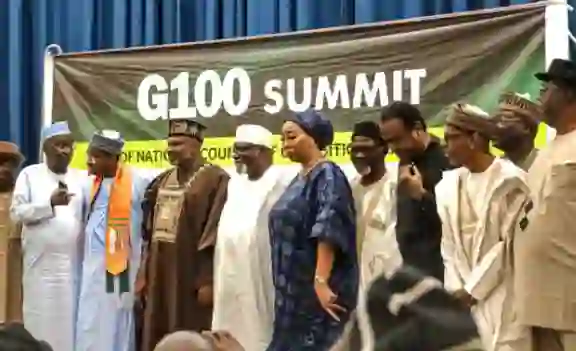
Six of Nigeria’s main opposition parties met in Abuja on Monday to lay the groundwork for a coalition aimed at unseating President Bola Tinubu in the 2027 elections, though three of the coalition’s biggest names — Atiku Abubakar, Peter Obi, and Seyi Makinde — were absent.
The African Democratic Congress (ADC), Nigeria Democratic Congress (NDC), Allied Peoples Movement (APM), a Peoples Democratic Party (PDP) faction, Peoples Redemption Party (PRP), and Social Democratic Party (SDP) sent representatives to the summit, including presidential and vice-presidential candidates Adewole Adebayo (SDP), Donald Duke (PRP), and Lawal Musa Daura (APM’s VP candidate). The Presidency did not respond to requests for comment.
Single-term proposal at the centre
Speaking on behalf of the G-100, Salihu Lukman unveiled a proposal for a “Government of National Competence” built around a single four-year transition term, to be enshrined in what he called an enforceable transition charter. He argued that Nigeria’s opposition has never lacked sincere promises, only the means to enforce them, and insisted any agreement from the summit must be written and binding — not symbolic.
Lukman drew a direct line to the 2023 election, where he said opposition votes were split so badly that the winner claimed victory with under nine million votes while two other candidates combined for roughly thirteen million between them. He described the loss as self-inflicted, pointing to Kenya’s 2002 election and Malaysia’s 2018 vote as examples where opposition coalitions unseated long-ruling governments by choosing unity over division.
He also outlined a three-tier coalition structure — a Central Leadership Committee, a publicity and communications committee, and a legal committee — with the G-100 acting only as facilitator. Five working groups, drawn one from each party, are to submit position papers within four weeks covering a national covenant for democratic renewal, the single-term transition charter, a reform programme, a framework for opposition unity, and a roadmap toward a single presidential candidate. Lukman was careful to clarify that no party is being asked to dissolve, merge, or drop its candidate at this stage.
Party leaders back the push
Minority Leader Fred Agbedi told the summit the House of Representatives’ Minority Caucus would partner with the G-100 to help streamline opposition ambitions, warning that a repeat of 2023’s fragmentation would again hand victory to the ruling party. PRP’s Donald Duke said he was prepared to step aside for a jointly agreed candidate, arguing that personal ego has repeatedly cost the opposition victory.
Party chairmen and officials from the ADC, APM, PDP faction, PRP, SDP, and NDC all pledged support for the process, with several invoking Osun State’s governorship result as proof that federal muscle and financial resources don’t guarantee electoral outcomes. PRP chairman Hakeem Baba-Ahmed noted that all six parties are currently facing legal challenges, describing it as “an existential threat,” but vowed the coalition would press ahead regardless.
Communiqué
At the close of the summit, the parties formally established the three coalition committees and the five working groups, and set a four-week deadline for their reports ahead of a second summit. The communiqué also called on the United States government to release official records concerning President Tinubu that bear on public interest, a position the parties said they would formally convey to the ECOWAS Commission.
Meanwhile, Atiku Abubakar’s camp denied he had boycotted the summit. His spokesman, Phrank Shaibu, said the former vice president’s absence was unavoidable and that Atiku remains fully committed to building a coalition capable of defeating the APC in 2027.
READ ALSO:
- 2027: Sambo Says No Party Can Match APC’s Organisation
- Odumeje Reveals How Former Friends Attacked Him For Preaching Gospel
- Japan Festival Turns Tragic As Deputy Mayor Is Crushed To Death By Heavy Float
- 2027: Lagos APC Warns Peter Obi Against Relying on 2023 Popularity
- Musk promises SpaceX shares to every American child
