


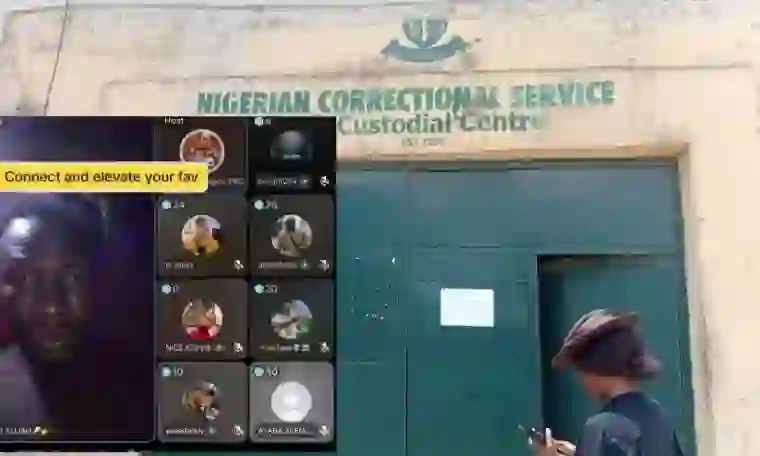
A death-row inmate at the Ibara Custodial Centre in Abeokuta has run multiple TikTok accounts from inside the facility, livestreaming to thousands of followers and collecting cash donations, an investigation by Premium Times has found.
Elijah Oyebode was sentenced to death by hanging in 2019 for the murder of Rofiat Adebisi, a final-year student at Osun State University’s Ipetu Ijesha campus. Justice S.O. Falola convicted him after rejecting his shifting accounts of the killing, which ranged from claims that Adebisi died after a consensual visit to his apartment to a claim that he used a herbalist’s charm to hypnotise her before taking her to a shrine.
Court records show Adebisi was waiting by the roadside for transport to Osogbo on December 22, 2016, when Oyebode picked her up.
Despite his conviction, Oyebode has kept an active online presence from behind bars. As of Friday, he was running at least two TikTok accounts, including one under the handle @ayola.oluwafu that has reached Level 20 gifting status — a marker of heavy financial activity on the platform. He appears regularly on livestreams, chatting with viewers and collecting gifts, many of whom don’t know he’s on death row.
A second account allegedly impersonated TikTok host and activist Omolola Awoyele, using her name and photo. Awoyele said Oyebode apologised and took the photo down after she confronted him, but forensic checks of TikTok data show the account posted content in the same window as his main page.
Awoyele said she first came across Oyebode through a friend’s livestream. “When I joined the live, I heard someone saying he was in prison,” she said. “I immediately wondered what a prisoner was doing on TikTok. He responded that social media was his only means of getting food and survival support.”
She doubted him at first and asked for a video call to confirm his location. “Through the video call, I confirmed that he was indeed in prison,” she said. Awoyele initially believed his claims of innocence and connected him with lawyers to pursue an appeal, but later obtained the certified court records and confronted him with the evidence. An appellate lawyer eventually withdrew from the case, and Awoyele cut contact after Oyebode allegedly began threatening her.
During one of Awoyele’s livestreams on April 16, Oyebode claimed phone smuggling was widespread among inmates at Ibara. “An individual may be in possession of two to three phones,” he said. “Facebook and TikTok are full of prisoners. They will not disclose their location to anyone.”
He said most of the money he receives comes from strangers online rather than family, and claimed he’d won ₦85,000 on a bet the previous month. He alleged officers smuggle in phones for a fee at the tarmac, and that rival officers who spot the devices sometimes seize them and demand payment for their return. He made similar allegations about drugs, claiming inmates buy them for around ₦500,000, pay officers ₦100,000 to smuggle them in, then resell for as much as ₦2 million. He also alleged that some wealthy inmates are escorted out of the facility by officers to check on personal property. None of these claims have been independently verified.
“I will not deceive you; it is no longer a correctional centre. It is corrupting people more,” Oyebode said.
The Nigerian Correctional Service Act, 2019 bars unauthorised communication devices in custodial facilities. Under Section 29(1)(c), officers who help inmates access such devices face fines of up to ₦3 million, up to three years in prison, or both. Legal experts say escorting a condemned inmate outside custody for personal errands has no legal basis and could expose officers to prosecution.
NCoS spokesperson Jane Osuji said the service could not immediately confirm the specific claims but acknowledged some officers may be compromised. “I cannot sit down here and tell you that it is true or it’s not true because where there are so many individuals, there will be one or two bad eggs in them,” she said. “We want a situation where we can work together so that we can have evidence of this, track it, and get both the inmates and the officers that are enabling this.”
Osuji called unauthorised internet access inside prisons a serious security risk. “If they can join a live social media platform for fun or monetary value, they can as well do anything from the comfort of their cells,” she said. “When they are able to organise their criminal activities from behind the walls of the correctional service, then you and I are in for it.”
The NCoS said it has disciplined more than 1,400 officers over various infractions, including dismissals, demotions and suspensions, and that tactical teams carry out unannounced searches to seize prohibited items. It said CCTV installation across custodial facilities is also in the works.
Osuji urged the public to stop sending money or gifts to inmates running unauthorised accounts. “If inmates continue to receive such assistance without reports being made to the authorities, they may leave correctional facilities worse than when they entered, defeating the purpose of correction and rehabilitation,” she said.
The service did not explain how Oyebode was able to run several accounts, livestream, receive money and place bets over an extended period while under a death sentence.
READ ALSO:
- Minister of Interior Orders Full-Scale Probe Into Niger State Detention Incident as NSCDC State Commandant, Key Officers Step Aside
- All hail the Miracle Working Olubunmi Tunji-Ojo
- Tongues wag on Adeshola Adeduntan’s Chieftaincy Soiree over Absence of Wife
- When Esama Shutdown Benin for 92nd Birthday Shindig
- Olowu Kuta Celebrates 14 years of Impact on the throne
