


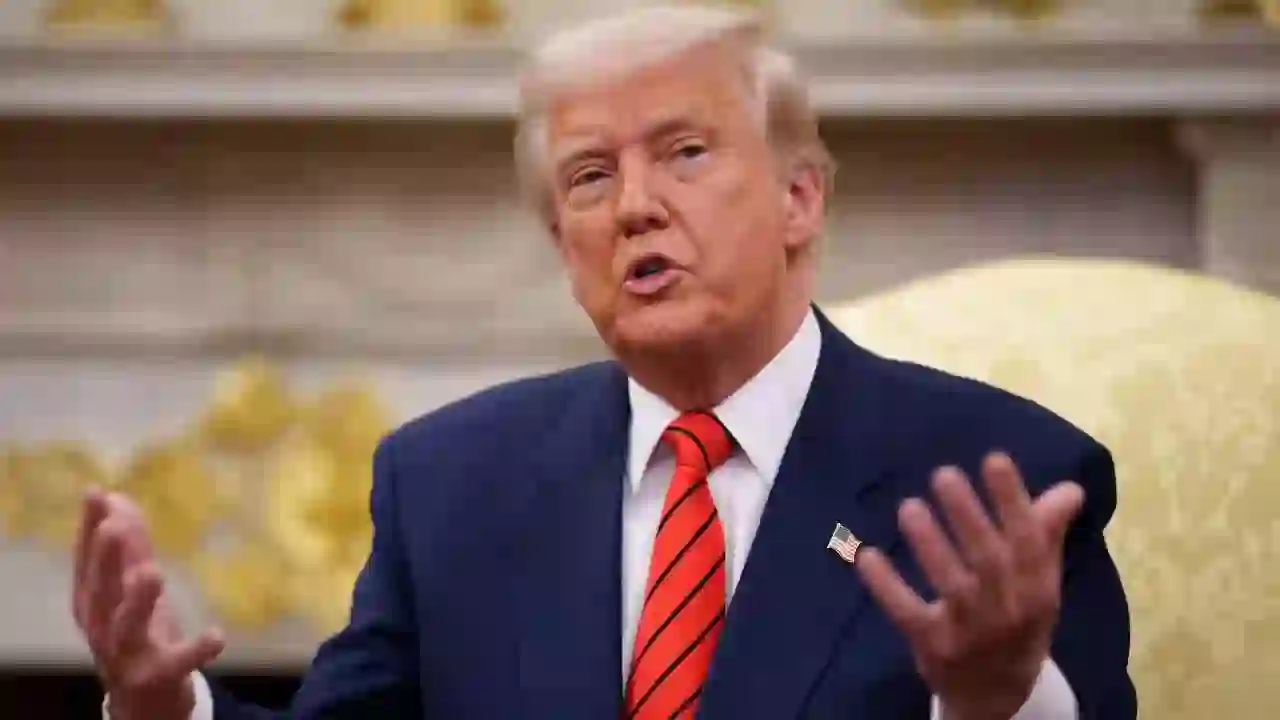
Global oil prices fell sharply after United States President Donald Trump expressed optimism that the strategic Strait of Hormuz could soon reopen to commercial shipping, while warning that Iran would face severe military consequences if ongoing diplomatic efforts failed.
Speaking during a visit to California, Trump said negotiations aimed at restoring maritime traffic through the vital waterway were making significant progress, adding that Iran appeared ready to bring months of hostilities to an end.
“We’re having very good discussions,” Trump said. “The Strait of Hormuz will open very soon, or Iran will be hit very hard.”
His remarks came shortly after U.S. Secretary of State Marco Rubio and Treasury Secretary Scott Bessent disclosed that diplomatic talks had advanced considerably and suggested commercial vessels could resume using the strait later this week.
Oil Prices Drop as Markets React
The encouraging comments from Washington immediately influenced global energy markets.
Brent crude, the international benchmark for oil, plunged nearly five percent on Tuesday to below $80 per barrel before extending losses by another 0.7 percent during Wednesday’s Asian trading session.
In the United States, West Texas Intermediate (WTI) crude also declined by more than five percent, settling around $76 per barrel.
The declines pushed both major oil benchmarks to their lowest levels since mid-July, reflecting renewed investor confidence that one of the world’s most important energy shipping routes could soon reopen.
However, market analysts cautioned that prices remain highly volatile, noting that several previous attempts to broker peace between the United States and Iran had collapsed, triggering fresh spikes in oil prices.
Washington Signals Progress in Talks
Secretary of State Marco Rubio confirmed that discussions involving Iran and Oman had yielded encouraging developments, although no final agreement had yet been reached.
According to Rubio, negotiators were making steady progress and hoped to conclude discussions in the near future.
Treasury Secretary Scott Bessent also expressed optimism, saying a breakthrough could come within days.
He stated that there was a realistic possibility that an agreement could be finalized quickly, paving the way for the reopening of the Strait of Hormuz and helping ease tensions in the region.
When asked whether Iran would be allowed to charge commercial vessels using the waterway, Bessent responded that the arrangement would guarantee “freedom of movement” for all ships.
Despite the positive tone from American officials, neither Washington nor its negotiating partners disclosed details of the proposed agreement.
Iran Rejects Claims of Direct U.S. Negotiations
Iran, however, denied engaging in direct negotiations with the United States.
Tehran maintained that all diplomatic discussions were being conducted through Oman, which has continued to serve as an intermediary between both governments.
A spokesperson for Iran’s Foreign Ministry described talks with Oman regarding a new mechanism for regulating commercial traffic through the Strait of Hormuz as constructive.
Qatar, another country facilitating diplomatic contacts between Washington and Tehran, also confirmed that mediation efforts were continuing but clarified that no direct negotiations between the United States and Iran were currently scheduled.
Why the Strait of Hormuz Matters
The Strait of Hormuz remains one of the world’s most strategically important maritime passages.
Before conflict erupted earlier in the year, nearly one-fifth of global daily oil exports and liquefied natural gas shipments passed through the narrow waterway.
Following the outbreak of hostilities, Iran suspended most commercial traffic through the strait, while the United States strengthened its naval presence around Iranian ports.
Despite the tensions, the U.S. Central Command said the southern navigation route through the Strait of Hormuz remains open for commercial vessels operating in international waters.
Military officials emphasized that ships using the southern corridor could continue their journeys safely under current conditions.
Red Sea Attacks Increase Shipping Risks
Shipping disruptions have also intensified along the Red Sea, where Yemen’s Iran-backed Houthi rebels have maintained a blockade affecting Saudi Arabian ports since late July.
The Red Sea had become an important alternative route after restrictions in the Strait of Hormuz, but repeated attacks on commercial vessels have increased security concerns.
On Tuesday, an Indian-flagged cargo vessel was reportedly struck by a projectile near Yemeni waters.
Indian authorities later confirmed that all 14 crew members aboard the vessel were rescued safely.
U.S. Missile Supplies Reportedly Running Low
As the conflict continues, reports indicate that the United States has significantly depleted its stockpile of long-range precision-guided missiles.
Sources familiar with the military campaign claimed that a substantial portion of America’s global inventory of the weapons has already been used during the ongoing conflict, increasing pressure on both military planners and diplomatic negotiators to secure a peaceful resolution.
Fuel Prices Remain High Despite Oil Decline
Although crude oil prices have fallen over the past few days, motorists around the world continue to face elevated fuel costs.
In the United Kingdom, average petrol prices have climbed to approximately £1.60 per litre, matching levels seen at the beginning of the conflict.
Across the United States, gasoline prices have risen above $4 per gallon, while diesel prices now approach $5.40 per gallon.
Throughout the crisis, oil prices have repeatedly surged above $120 per barrel whenever fighting intensified before retreating as diplomatic efforts resumed.
The volatility has allowed major international energy companies, including BP, Shell, Chevron and Exxon Mobil, to record strong financial performances.
Investors Remain Cautious
Despite the latest diplomatic progress, financial analysts warned that investors remain cautious given the repeated collapse of previous peace efforts.
AJ Bell’s Head of Financial Analysis, Danni Hewson, noted that financial markets were reluctant to celebrate too early because earlier negotiations had repeatedly failed to deliver lasting peace.
She explained that investors remain aware of how fragile the diplomatic process has become and warned that energy markets continue to be heavily influenced by President Trump’s unpredictable policy decisions.
Earlier in the week, Trump described the current negotiations as Iran’s “last chance” to restore commercial shipping through the Strait of Hormuz.
He also revealed that he had postponed planned large-scale military strikes to allow diplomacy one final opportunity to succeed.
READ ALSO:
- CBN Cuts Interest Rate to 23%
- ITC, Access Bank Partner to Support Small Businesses Across 14 African Countries
- Governor Dauda Lawal Approves 95% Salary Increase for Health Workers
- Trump Launches “Trump TV” as White House Bars CNN, MS NOW, Politico Over Coverage Dispute
- “Not A Threat, But A Promise” — IPOB Renews 2027 Election Boycott Threat Over Kanu
