


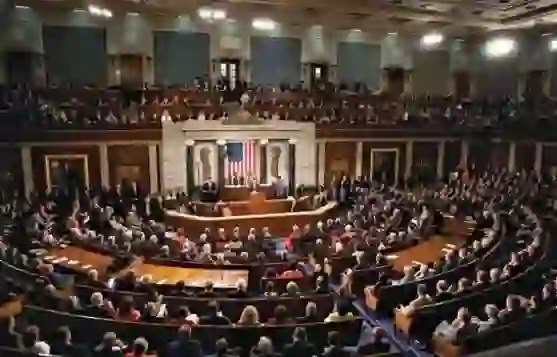
Nigeria risks a major humanitarian setback after the US House of Representatives voted to withhold all American assistance to the country over allegations of continued killings of Christians and worsening insecurity.
The measure is not yet law, but health experts and development stakeholders warn that if the Senate approves it and President Donald Trump signs it, the fallout could gut life-saving health programmes, push thousands of aid workers into unemployment, and reverse gains against HIV/AIDS, tuberculosis, malaria, and maternal deaths.
They described Nigeria’s heavy reliance on foreign donors as a national vulnerability now laid bare.
Congressman Gregory Steube sponsored the amendment, adopted during the House’s consideration of the 2027 State Department Appropriations Bill. He said American taxpayers should not fund governments that ignore the abduction, torture and killing of Christians.
The amendment raises an earlier proposal — a 50 per cent aid suspension — to a full freeze, one that would only lift once the US Secretary of State certifies that Nigeria has taken measurable steps to end the violence and prosecute those responsible. The bill still needs Senate approval and presidential assent to become law.
Decades of support
Nigeria has been among America’s largest aid recipients for over two decades. Washington gave $1.16 billion in 2022, about $1.02 billion in 2023, and roughly $767 million in 2024, mostly channelled through USAID and PEPFAR.
The US has committed more than $6 billion to Nigeria’s HIV response through PEPFAR alone, supporting treatment for over 1.5 million Nigerians. In 2024, US-backed programmes also delivered malaria medicine to 2.2 million children, funded HPV vaccinations for 13 million girls, and screened 19.8 million Nigerians for tuberculosis.
A breakdown of the 2024 assistance shows $370 million went to health, $310 million to humanitarian aid, $35 million to administration, $24 million to education, and $7.8 million to agriculture.
On security, the US gave $40 million in military assistance and trained 60 Nigerian military personnel in 2024. More than $50 million went into criminal justice and civilian security reforms, expanding legal aid to over 5,000 Nigerians. Farmers also accessed over $55 million in US-backed agricultural financing.
“A serious diplomatic warning”
Chairman of the Public Health Sustainable Advocacy Initiative, Barrister Ayo Adebusoye, said the vote, though not yet binding, should not be dismissed by government.
“Nigeria should see this as a serious diplomatic warning, not just another aid issue,” he said, adding that the concern extends beyond money to insecurity and accountability.
Adebusoye cautioned against framing the crisis as a religious one, noting that victims cut across Christians, Muslims, farmers, and humanitarian workers alike. He said government’s duty is to protect all citizens and prosecute perpetrators without discrimination.
He warned that Nigeria’s HIV, tuberculosis, malaria, immunisation and maternal health programmes depend heavily on US support, and that any disruption would hit the supply of medicines, diagnostics and vaccines.
Calling Nigeria’s donor dependence a structural weakness, he urged banks, telecoms and other profitable sectors to help fund domestic health financing instead of leaving the burden to USAID and other foreign donors. He also pointed to Nigeria’s history as a donor nation in the 1960s and 70s, saying the country should treat the current moment as an opportunity to strengthen governance and build domestic capacity rather than as a fresh dependency crisis.
He called on Abuja to step up diplomatic engagement with Washington while showing measurable progress on security.
“Double jeopardy for Nigerians”
National President of the Association of Medical Laboratory Scientists of Nigeria, Dr Casmir Ifeanyi, described the proposed freeze as a double blow for ordinary Nigerians, who would suffer both from insecurity and from the loss of aid.
While agreeing that the killings warrant international concern, he said withdrawing aid entirely was disproportionate. “But withdrawing aid is like killing an ant with a sledgehammer,” he said.
Ifeanyi said the crisis has touched him personally. More than 11 communities near his hometown of Amufu, stretching from the Benue State boundary through parts of Enugu State, have been overrun by bandits, he said, and the violence has displaced his people and claimed his mother’s life.
He put the US share of Nigeria’s international health assistance at over 70 per cent, warning that a full withdrawal would devastate HIV treatment, tuberculosis control, malaria prevention, maternal care and immunisation — with poor women and children bearing the brunt.
He pointed to Washington’s earlier funding withdrawal from the World Health Organisation as a preview of what a full aid cut could mean for Nigeria.
Still, Ifeanyi said Nigeria must confront its own failures, arguing that corruption and poor governance, not a lack of resources, are the country’s real problem. He urged government to tackle insecurity and block financial leakages so Nigeria is no longer at the mercy of foreign policy decisions.
Experts agree the House vote, while not yet final, should push Nigeria to boost domestic health financing and address the insecurity now drawing global scrutiny.
READ ALSO:
- Davido Mocks MC Oluomo Over Rejection Of Adeleke’s NURTW Ban
- Three-storey hostel collapses in Anambra, trapping students
- BBNaija: UK-Trained Temi Nkem Blasts Housemates Over ‘Poor English’
- Coup Suspect Admits Calling Tinubu “Scared” After Parade Cancellation
- US Embassy Tells Dual Citizens To Stop Using Foreign Passports To Enter, Exit America
